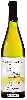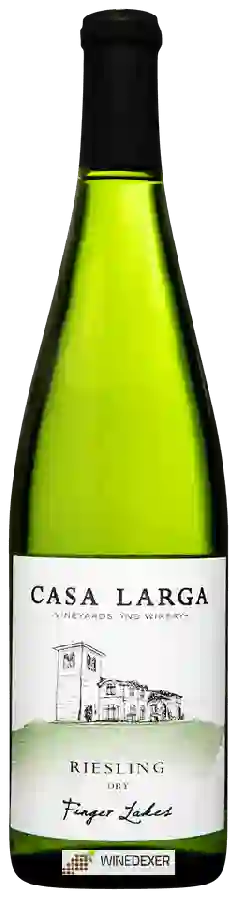
Winery Casa LargaRiesling Dry
 White wine


This wine generally goes well with pork, vegetarian or poultry.

Food and wine pairings with Riesling Dry
Pairings that work perfectly with Riesling Dry



Original food and wine pairings with Riesling Dry



The Riesling Dry of Winery Casa Larga matches generally quite well with dishes of pork, rich fish (salmon, tuna etc) or spicy food such as recipes of pizza calzone with ham and mushrooms, tuna nuggets or scallops with coconut cream.
Details and technical informations about Winery Casa Larga's Riesling Dry.
Discover the grape variety: Riesling
Crystalline, taut whites with vibrant acidity and aromas of citrus, green apple, white flowers, vineyard peach and mineral/petrol notes with age. Made as dry (Trocken, Alsace), off-dry (Kabinett, Spätlese) and sweet (Auslese, Beerenauslese, Trockenbeerenauslese, late harvest). Star of the Moselle, Rheingau, Alsace AOC and Wachau. Also exported to Clare Valley and Finger Lakes.
Last vintages of this wine
The best vintages of Riesling Dry from Winery Casa Larga are 2016, 0
Informations about the Winery Casa Larga
The Winery Casa Larga is one of of the world's great estates. It offers 47 wines for sale in the of Finger Lakes to come and discover on site or to buy online.

The wine region of Finger Lakes
Quality hub of the American northeast, signature Riesling: dry, lively, mineral whites with notes of green apple, lemon, white peach and wet stone, sharp acidity comparable to the best Germans. Also off-dry and sweet botrytised versions. Precise Chardonnay, fine, fresh Pinot Noir (red fruits), peppery Cabernet Franc. Continental climate tempered by 11 glacial lakes (Cayuga, Seneca).
The wine region of New York
America's 3rd wine state by volume, striking diversity. Finger Lakes the signature: cool-climate Riesling, dry to off-dry, mineral and lively with notes of lime, apple, evolving petrol and white flowers — a US benchmark. Warmer Long Island for peppery Cabernet Franc and supple Merlot. Hudson Valley (Seyval, Vidal).
The word of the wine: Terroir
Strictly speaking, the notion of terroir corresponds to the geological characteristics of a vineyard. However, when we talk about terroir, we take into account the soil, the climate (even the microclimate), the flora, the fauna, and the human factor that characterizes the practices that make up the art of the craft.