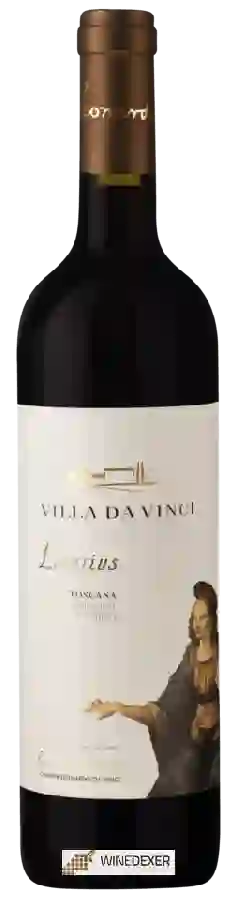
Winery Cantine Leonardo da VinciLinarius
 Red wine


In the mouth this red wine is a powerful.
This wine generally goes well with poultry, beef or veal.
Taste structure of the Linarius from the Winery Cantine Leonardo da Vinci
Light | Bold | |
Smooth | Tannic | |
Dry | Sweet | |
Soft | Acidic |
In the mouth the Linarius of Winery Cantine Leonardo da Vinci in the region of Tuscany is a powerful.
Wine flavors and olphactive analysis


On the nose the Linarius of Winery Cantine Leonardo da Vinci in the region of Tuscany often reveals types of flavors of black fruit.
Food and wine pairings with Linarius
Pairings that work perfectly with Linarius



Original food and wine pairings with Linarius


The Linarius of Winery Cantine Leonardo da Vinci matches generally quite well with dishes of beef, lamb or veal such as recipes of tata simone's dumplings, irish stew with beer or puchero.
Details and technical informations about Winery Cantine Leonardo da Vinci's Linarius.
Discover the grape variety: Othello
Interspecific cross between the Clinton and the frankenthal or black-hamburg obtained in 1859 by Charles Arnold of Paris in Canada (Brant County in Ontario). In France, it is one of the six hybrids prohibited since 1935 (included in the European regulations): the Clinton, the Herbemont, the Isabelle, the Jacquez, the Noah and the Othello. It has been used as a sire in several crosses, notably by Couderc and Seibel. Today, the Othello has practically disappeared.
Last vintages of this wine
The best vintages of Linarius from Winery Cantine Leonardo da Vinci are 2016, 0
Informations about the Winery Cantine Leonardo da Vinci
The Winery Cantine Leonardo da Vinci is one of of the world's great estates. It offers 86 wines for sale in the of Tuscany to come and discover on site or to buy online.

The wine region of Tuscany
Tuscany is one of the most famous and prolific wine regions in Europe. It is best known for its Dry red wines made from Sangiovese grapes, which dominate production. These include Chianti, Brunello di Montalcino and Vino Nobile di Montepulciano. The region's Vin Santo is also highly prized, as are its passito dessert wines, though these are produced in comparatively tiny quantities.
The word of the wine: Flavours
There are generally four so-called fundamental flavours: acidity, bitterness, sweetness and saltiness. The first three are considered to be the building blocks of the structure of wines. They are perceived by the taste buds that cover the surface of the tongue.