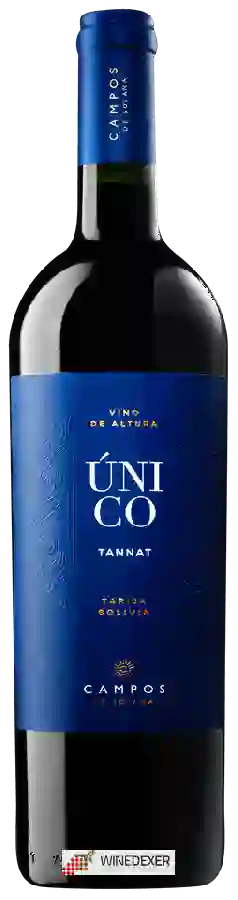
Winery Campos de SolanaÚnico Tannat
 Red wine


This wine generally goes well with beef
The Único Tannat of the Winery Campos de Solana is in the top 10 of wines of Bolivia and in the top 10 of wines of Tarija.

Wine flavors and olphactive analysis




On the nose the Único Tannat of Winery Campos de Solana in the region of Tarija often reveals types of flavors of non oak, earth or oak and sometimes also flavors of spices, black fruit.
Food and wine pairings with Único Tannat
Pairings that work perfectly with Único Tannat

Original food and wine pairings with Único Tannat
The Único Tannat of Winery Campos de Solana matches generally quite well with dishes of beef such as recipes of beef luc lake.
Details and technical informations about Winery Campos de Solana's Único Tannat.
Discover the grape variety: Tannat
Powerful, tannic reds with inky colour and dense texture, with aromas of blackberry, blackcurrant, black plum, leather, liquorice and smoky notes. Very high ageing potential and polyphenol content (health reputation). Star of Madiran AOC in Béarn and the national grape of Uruguay (Canelones, Maldonado). Also grown in Irouléguy and Tursan. Late-ripening red variety from south-west France.
Last vintages of this wine
The best vintages of Único Tannat from Winery Campos de Solana are 2018, 2017, 2015, 0 and 2019.
Informations about the Winery Campos de Solana
The Winery Campos de Solana is one of of the world's greatest estates. It offers 27 wines for sale in the of Tarija to come and discover on site or to buy online.

The wine region of Tarija
Wine capital of Bolivia, ~80% of national vineyard, vines planted between 1,600 and 2,350 m altitude (among the highest in the world). Very sunny dry climate, strong day-night temperature range. Muscat of Alexandria is the signature white king (~70%): aromatic and floral with fresh grape, citrus, white flowers, peach and honey — base of Singani, national spirit comparable to Pisco. Dense Malbec (blackberry, plum, violet, spices), firm Tannat and Cabernet in modern reds.
The word of the wine: Phenolic ripeness
A distinction is made between the ripeness of sugars and acids and the ripeness of tannins and other compounds such as anthocyanins and tannins, which will bring structure and colour. Grapes can be measured at 13° potential without having reached this phenolic maturity. Vinified at this stage, they will give hard, astringent wines, without charm.