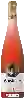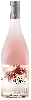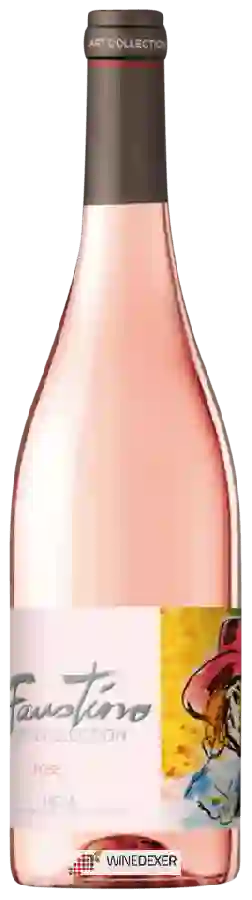
Bodegas FaustinoArt Collection Garnacha Rosé
 Pink wine



This wine generally goes well with pork, beef or lamb.
Food and wine pairings with Art Collection Garnacha Rosé
Pairings that work perfectly with Art Collection Garnacha Rosé



Original food and wine pairings with Art Collection Garnacha Rosé

The Art Collection Garnacha Rosé of Bodegas Faustino matches generally quite well with dishes of beef, lamb or pork such as recipes of shoulder of suckling lamb confit with herbs, oriental lamb skewers or cannelloni of meat.
Details and technical informations about Bodegas Faustino's Art Collection Garnacha Rosé.
Discover the grape variety: Carmenère
Carménère is a grape variety of Bordeaux origin. It is the result of a cross between Cabernet Franc and Gros Cabernet. In France, it occupies only about ten hectares, but it is also grown in Chile, Peru, the Andes, California, Italy and Argentina. The leaves of the carmenere are shiny and revolute. Its berries are round and medium-sized. Carménère is susceptible to grey rot, especially in wet autumn. It can also be exposed to the risk of climatic coulure, which is why it is important to grow it on poor soil and in warm areas. Carménère is associated with an average second ripening period. This variety has only one approved clone, 1059. It can be vinified with Cabernet Sauvignon and Merlot. It produces a rich, highly coloured wine, which acquires character when combined with other grape varieties.
Last vintages of this wine
The best vintages of Art Collection Garnacha Rosé from Bodegas Faustino are 2018, 0, 2019
Informations about the Bodegas Faustino
The Bodegas Faustino is one of of the world's great estates. It offers 57 wines for sale in the of Rioja to come and discover on site or to buy online.

The wine region of Rioja
Rioja, in northern Spain, is best known for its berry-flavored, barrel-aged red wines made from Tempranillo and Garnacha. It is probably the leading wine region in Spain. It is certainly the most famous, rivaling only Jerez. The Vineyards follow the course of the Ebro for a hundred kilometres between the towns of Haro and Alfaro.
The word of the wine: Tertiary aromas
Aromas resulting from the aging of the wine in the bottle. The aromas evolve with time, from fresh fruitiness to notes of stewed, candied or dried fruit, to aromas of venison or undergrowth.