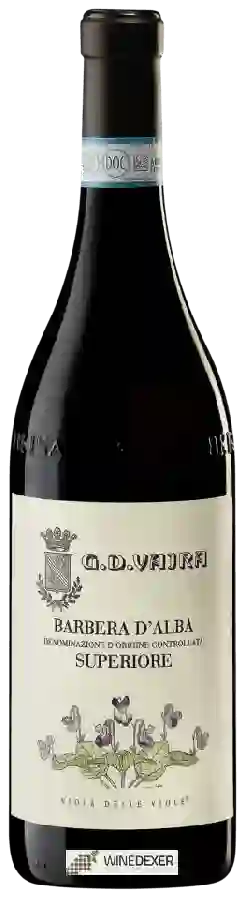
Winery G.D. VajraBarbera d'Alba Superiore
 Red wine


In the mouth this red wine is a powerful with a nice freshness.
This wine generally goes well with pork, poultry or veal.

Taste structure of the Barbera d'Alba Superiore from the Winery G.D. Vajra
Light | Bold | |
Smooth | Tannic | |
Dry | Sweet | |
Soft | Acidic |
In the mouth the Barbera d'Alba Superiore of Winery G.D. Vajra in the region of Piedmont is a powerful with a nice freshness.
Wine flavors and olphactive analysis






On the nose the Barbera d'Alba Superiore of Winery G.D. Vajra in the region of Piedmont often reveals types of flavors of cream, cherry or oaky and sometimes also flavors of smoke, earthy or blackberry.
Food and wine pairings with Barbera d'Alba Superiore
Pairings that work perfectly with Barbera d'Alba Superiore



Original food and wine pairings with Barbera d'Alba Superiore


The Barbera d'Alba Superiore of Winery G.D. Vajra matches generally quite well with dishes of pasta, veal or pork such as recipes of vegetarian lasagna, veal roast casserole with mushrooms or tartiflette.
Details and technical informations about Winery G.D. Vajra's Barbera d'Alba Superiore.
Discover the grape variety: Trebbiano Toscano
Neutral, fresh dry whites with a pale golden robe, a supple palate and preserved acidity, with subtle aromas of citrus (lemon), white flowers and herbal notes. A rustic, productive profile. Component of Italian DOC whites (Vin Santo, white Chianti), massively used for Cognac distillation (as Ugni Blanc) and Jerez brandy. The most widely planted Trebbiano variety in Italy, grown mainly in Tuscany and Emilia-Romagna.
Last vintages of this wine
The best vintages of Barbera d'Alba Superiore from Winery G.D. Vajra are 2017, 2015, 2012, 2010 and 2016.
Informations about the Winery G.D. Vajra
The Winery G.D. Vajra is one of of the world's greatest estates. It offers 27 wines for sale in the of Barbera d'Alba to come and discover on site or to buy online.

The wine region of Barbera d'Alba
Premium Piedmontese Barbera around Alba (heart of the Langhe). Fleshier, more concentrated reds than neighbouring Asti, with signature notes of ripe black cherry, candied plum, violet and sweet spices, characteristic fresh acidity and round tannins. Frequent barrel ageing (chocolate, vanilla). Generous palate, accessible young, age-worthy Superiore versions.
The wine region of Piedmont
Kingdom of Nebbiolo: Barolo and Barbaresco DOCG, long-ageing reds with firm tannins and lively acidity, complex aromas of withered rose, sour cherry, tar, truffle and undergrowth. More accessible, tangy Barbera on red fruit, supple, crisp Dolcetto. Sweet, floral sparkling Moscato d'Asti, mineral, lemony Gavi (Cortese) white, round, almondy Arneis from Roero. 50,000 ha across the Langhe, Roero and Monferrato, UNESCO.
The word of the wine: Tartar (deposit)
White, chalky deposits that occur as a result of precipitation inside bottles and are often considered by consumers as a defect. They are in fact tartaric salts formed by tartaric acid, potassium and calcium naturally present in the wine. This deposit does not alter the quality of the wine and can be eliminated by a simple decanting.