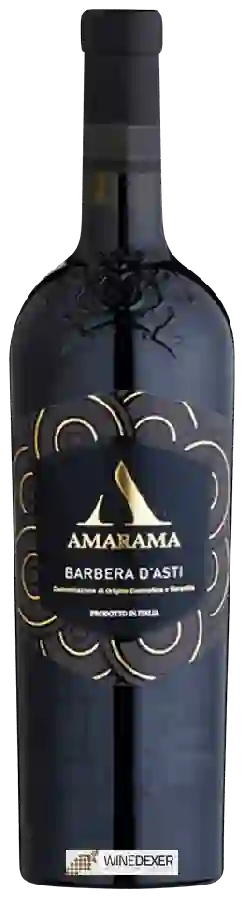
Winery AmaramaBarbera d'Asti
 Red wine


In the mouth this red wine is a powerful with a nice freshness.
This wine generally goes well with pork, poultry or veal.

Taste structure of the Barbera d'Asti from the Winery Amarama
Light | Bold | |
Smooth | Tannic | |
Dry | Sweet | |
Soft | Acidic |
In the mouth the Barbera d'Asti of Winery Amarama in the region of Piedmont is a powerful with a nice freshness.
Food and wine pairings with Barbera d'Asti
Pairings that work perfectly with Barbera d'Asti



Original food and wine pairings with Barbera d'Asti


The Barbera d'Asti of Winery Amarama matches generally quite well with dishes of pasta, veal or pork such as recipes of pasta alla norma, veal paupiettes with white wine or tripe in the style of caen.
Details and technical informations about Winery Amarama's Barbera d'Asti.
Discover the grape variety: Favorita
Lively, aromatic dry whites with a pale golden robe, an elegant palate and preserved acidity, with signature aromas of citrus (lemon, grapefruit), white flowers (acacia), white-fleshed fruits (apple, pear) and saline notes. Refreshing profile, best drunk young. Grown in the Roero and Langhe, a Piedmontese alternative to Ligurian Vermentino. Genetically identical to Vermentino, an autochthonous white variety from Piedmont.
Last vintages of this wine
The best vintages of Barbera d'Asti from Winery Amarama are 0, 2014
Informations about the Winery Amarama
The Winery Amarama is one of of the world's greatest estates. It offers 9 wines for sale in the of Barbera d'Asti to come and discover on site or to buy online.

The wine region of Barbera d'Asti
Apogee of Piedmont Barbera: a gourmet, vibrant red with signature notes of ripe cherry, raspberry, plum and violet, characteristic fresh acidity and supple tannins that make it immediately drinkable. A direct, everyday Italian style, perfect with charcuterie and pasta. Fleshier Superiore versions (14 months ageing) with liquorice and dark chocolate notes, and Nizza DOCG at the summit. 6,000 ha of clay-limestone hills between Asti and Alessandria.
The wine region of Piedmont
Kingdom of Nebbiolo: Barolo and Barbaresco DOCG, long-ageing reds with firm tannins and lively acidity, complex aromas of withered rose, sour cherry, tar, truffle and undergrowth. More accessible, tangy Barbera on red fruit, supple, crisp Dolcetto. Sweet, floral sparkling Moscato d'Asti, mineral, lemony Gavi (Cortese) white, round, almondy Arneis from Roero. 50,000 ha across the Langhe, Roero and Monferrato, UNESCO.
The word of the wine: Natural sweet wine
Wine obtained by mutage with wine alcohol of the must in the course of fermentation, from the Muscat, Grenache, Macabeu and Malvoisie grape varieties, and corresponding to strict conditions of production, richness and elaboration.