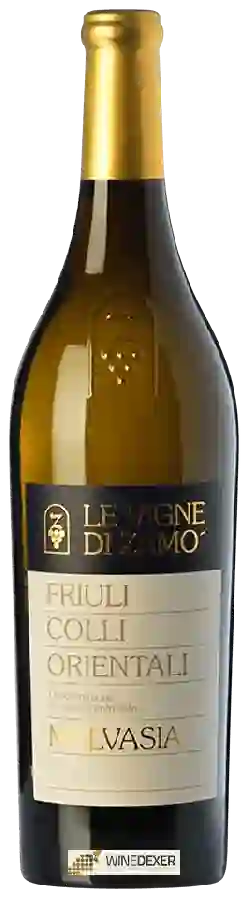
Winery Le Vigne di ZamòMalvasia
 White wine



In the mouth this white wine is a powerful with a nice freshness.
This wine generally goes well with lean fish, shellfish or mature and hard cheese.
Taste structure of the Malvasia from the Winery Le Vigne di Zamò
Light | Bold | |
Dry | Sweet | |
Soft | Acidic |
In the mouth the Malvasia of Winery Le Vigne di Zamò in the region of Friuli-Venezia Giulia is a powerful with a nice freshness.
Food and wine pairings with Malvasia
Pairings that work perfectly with Malvasia



Original food and wine pairings with Malvasia


The Malvasia of Winery Le Vigne di Zamò matches generally quite well with dishes of pasta, shellfish or mature and hard cheese such as recipes of mascarpone/gorgonzola macaroni gratin, calamari with chorizo or beaufort pie.
Details and technical informations about Winery Le Vigne di Zamò's Malvasia.
Discover the grape variety: Aubun
Aubun is not to be confused with another grape variety with the same sound, aubin. This one is a black grape plant of which the Vaucluse is the probable cradle. Covering nearly 5,400 hectares of vineyards in the late 1990s, its cultivation was reduced to some 1,400 hectares in the mid-2000s. California and Australia also have discreet plantations. In the Var, Lot-et-Garonne, Gers, Ardèche and other departments, aubun is authorized, if not recommended. Its third-period ripeness promises medium to large bunches of compact, cylindrical grapes that will produce medium-quality wine. Quite alcoholic, the wine produced from Aubun is a lightly colored red. After budburst, the shoots bear young branches covered with a cottony veil. The young leaves are yellowish and downy. The older ones have pubescent, cottony blades with 5 to 7 limbs.
Last vintages of this wine
The best vintages of Malvasia from Winery Le Vigne di Zamò are 2010, 2008, 0, 2009 and 2012.
Informations about the Winery Le Vigne di Zamò
The Winery Le Vigne di Zamò is one of of the world's great estates. It offers 35 wines for sale in the of Colli Orientali del Friuli to come and discover on site or to buy online.

The wine region of Colli Orientali del Friuli
The wine region of Colli Orientali del Friuli is located in the region of Frioul-Vénétie Julienne of Italy. Wineries and vineyards like the Domaine Livio Felluga or the Domaine Moschioni produce mainly wines red and white. The most planted grape varieties in the region of Colli Orientali del Friuli are Merlot, Schioppettino and Cabernet-Sauvignon, they are then used in wines in blends or as a single variety. On the nose of Colli Orientali del Friuli often reveals types of flavors of cherry, almonds or pineapple and sometimes also flavors of cream, citrus or apples.
The wine region of Friuli-Venezia Giulia
Friuli-Venezia Giulia is an autonomous region in Italy, located in the extreme Northeast of the country, bordered by Austria and Slovenia to the north and east respectively. The eponymous wine region has four DOCGs, twelve DOCs and three PGIs and is best known for its white wine production. 77% of the region's wines are white, one of the highest proportions of any Italian region. The region's wines are distinctly different from other Italian wines in that they are made from non-traditional Grape varieties such as Sauvignon blanc, Riesling and Pinot blanc, as well as typically Italian varieties such as pinot gris and picolit.
The word of the wine: Primeur (purchase in)
Purchase made shortly after the harvest and before the wine is ready for consumption.