The Weingut Vollenweider of Mosel
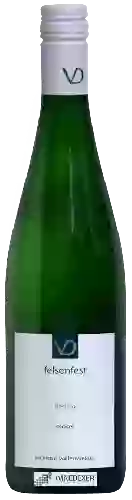
The Weingut Vollenweider is one of the best wineries to follow in Mosel.. It offers 23 wines for sale in of Mosel to come and discover on site or to buy online.
Looking for the best Weingut Vollenweider wines in Mosel among all the wines in the region? Check out our tops of the best red, white or effervescent Weingut Vollenweider wines. Also find some food and wine pairings that may be suitable with the wines from this area. Learn more about the region and the Weingut Vollenweider wines with technical and enological descriptions.
How Weingut Vollenweider wines pair with each other generally quite well with dishes of pork, shellfish or spicy food such as recipes of sauté of pork with cider, sublime fish and shrimp colombo or baked falafels.
On the nose the white wine of Weingut Vollenweider. often reveals types of flavors of earth, tree fruit or spices and sometimes also flavors of citrus fruit, floral or tropical fruit. In the mouth the white wine of Weingut Vollenweider. is a with a nice freshness.
Mosel is the most famous of Germany's 13 official wine regions, and also the third largest in terms of production. As with many German regions, it is most aasociated with a range of wine styles made from the Riesling grape variety, but Müller-Thurgau is also widely planted.
The best Mosel Riesling wines are some of the finest whites in the world. Light and low in Alcohol, they can be intensely fragrant with beguiling Floral">floral and Mineral notes, and a wonderful Balance of sweetness and Acidity.
The region follows the path of the Mosel river from its confluence with the Rhine river near Koblenz, upstream and south-west to Germany's border with Luxembourg and France. This region also includes the Saar and Ruwer tributaries, and was formerly known as Mosel-Saar-Ruwer until August 2007, when the name was officially shortened to Mosel.
Some of the famous wine villages along the valley include Bernkastel, Brauneberg, Erden, Graach and Piesport, to name but five. Furthermore, the region boasts some of the finest and most picturesque Vineyards in Europe.
The Romans planted the first vineyards along the Mosel river and the city of Trier around the second century. Today, this region is known for its steep slopes overlooking the rivers, on which the vineyards are planted.
Bremmer Calmont, located in the town of Bremm, has an incline of up to 68°. It has often been cited as the steepest vineyard site in the world, though the Engelsfelden vineyard in the Bühler Valley (Bühlertal) in the Baden region is documented at 75°.
How Weingut Vollenweider wines pair with each other generally quite well with dishes of pork, shellfish or spicy food such as recipes of special' tagliatelle carbonara, cuttlefish in sauce or couscous chicken and merguez.
On the nose the sweet wine of Weingut Vollenweider. often reveals types of flavors of citrus fruit, earth or tree fruit and sometimes also flavors of floral, vegetal or tropical fruit. In the mouth the sweet wine of Weingut Vollenweider. is a powerful with a good balance between acidity and sweetness.
Meslier Saint François is a French grape variety that comes from the Gatinais, located south of the Paris basin. It was obtained from a cross between Chenin and Gouais Blanc. It is planted on a surface area of 50 ha in France and is often confused with Arbois, hence the synonym it shares with the latter, Orbois. Its berries and clusters are of normal size. Its adult leaves have convex teeth. Meslier Saint François is not very vigorous, but it remains fertile. It buds early, 3 days before Chasselas. It is often exposed to spring frosts and is susceptible to oidium and grey rot. Meslier Saint François produces flat, light wines with little alcohol. When distilled, its eaux de vie are full of bouquet and fine. It can thus be used in the blending of grape varieties that produce cognac or armagnac.
Planning a wine route in the of Mosel? Here are the wineries to visit and the winemakers to meet during your trip in search of wines similar to Weingut Vollenweider.
This grape variety has been cultivated in Greece for a very long time - most often at high altitudes - more specifically in the Cyclades islands, the island of Rhodes, Crete, etc. and is practically unknown in other wine-producing countries, including France. We can meet the black aidani or mavro, very rare, it has however no link with the white or aspro.