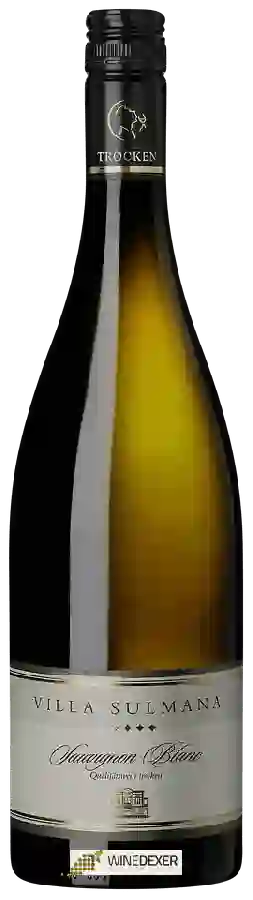
Winery Villa SulmanaSauvignon Blanc
 White wine



In the mouth this white wine is a with a nice freshness.
This wine generally goes well with vegetarian, shellfish or goat cheese.

Taste structure of the Sauvignon Blanc from the Winery Villa Sulmana
Light | Bold | |
Dry | Sweet | |
Soft | Acidic |
In the mouth the Sauvignon Blanc of Winery Villa Sulmana in the region of Württemberg is a with a nice freshness.
Food and wine pairings with Sauvignon Blanc
Pairings that work perfectly with Sauvignon Blanc



Original food and wine pairings with Sauvignon Blanc
The Sauvignon Blanc of Winery Villa Sulmana matches generally quite well with dishes of shellfish, vegetarian or goat cheese such as recipes of tagliatelle with scallops, light tuna-tomato quiche (without cream) or breaded cheese plate.
Details and technical informations about Winery Villa Sulmana's Sauvignon Blanc.
Discover the grape variety: Soreli
Aromatic, structured whites with a pale golden robe, an ample palate with preserved acidity, and signature aromas of white stone fruits (apple, pear), white flowers and mineral notes reminiscent of Friulano. Productive and disease-resistant. Grown in northern Italy for organic and sustainably managed vineyards. Italian white hybrid obtained in 2006 at the University of Udine, a disease-resistant cross involving Tocai Friulano.
Last vintages of this wine
The best vintages of Sauvignon Blanc from Winery Villa Sulmana are 0
Informations about the Winery Villa Sulmana
The Winery Villa Sulmana is one of of the world's greatest estates. It offers 7 wines for sale in the of Württemberg to come and discover on site or to buy online.

The wine region of Württemberg
Rare predominantly red region in Germany (nearly 70%). Supple, fruity everyday reds: light, crisp Trollinger (Schiava) with red fruits, more structured, spicy, deep Lemberger (Blaufränkisch), generous Schwarzriesling (Pinot Meunier). Riesling king of whites (>2,000 ha), lively and mineral, citrus and green apple. Germany's 4th region (11,500 ha) on the Neckar slopes around Heilbronn and Stuttgart.
The word of the wine: Muscat blanc à petits grains
A white grape variety cultivated since antiquity on the shores of the Mediterranean, it is considered the noblest of the muscats. It is mainly used to make sweet wines, often from mutage. In France, it is the sole variety used in many natural sweet wines: muscat-de-frontignan, muscat-de-mireval, muscat-de-lunel, muscat-de-saint-jean-de-minervois, muscat-de-beaumes-de-venise, muscat-du-cap-corse. Combined with Muscat d'Alexandrie, it gives Muscat-de-Rivesaltes. It is also used to make sparkling white wines (clairette-de-die; moscato d'asti and asti spumante in Italy) and dry wines (alsace-muscat). Powerfully aromatic and complex, its wines evoke fresh grapes, roses, exotic fruits, citrus fruits and spices.