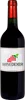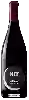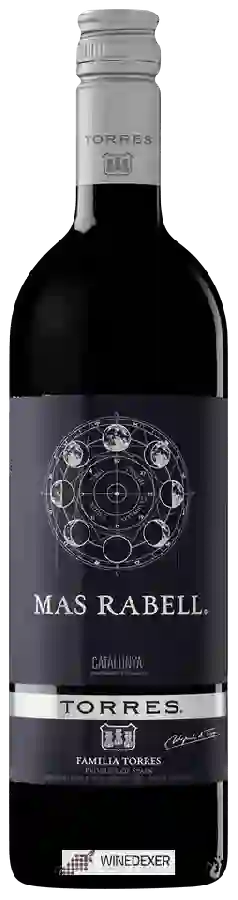
Winery TorresMas Rabell
 Red wine



In the mouth this red wine is a powerful with a nice freshness.
This wine generally goes well with poultry, beef or veal.
Taste structure of the Mas Rabell from the Winery Torres
Light | Bold | |
Smooth | Tannic | |
Dry | Sweet | |
Soft | Acidic |
In the mouth the Mas Rabell of Winery Torres in the region of Catalogne is a powerful with a nice freshness.
Wine flavors and olphactive analysis





On the nose the Mas Rabell of Winery Torres in the region of Catalogne often reveals types of flavors of cherry, oaky or earthy and sometimes also flavors of blackberry, red fruit or tobacco.
Food and wine pairings with Mas Rabell
Pairings that work perfectly with Mas Rabell



Original food and wine pairings with Mas Rabell

The Mas Rabell of Winery Torres matches generally quite well with dishes of beef, pasta or veal such as recipes of pasticcio (greece), pasta with mushroom sauce or adapted vietnamese fondue.
Details and technical informations about Winery Torres's Mas Rabell.
Discover the grape variety: Helfensteiner
Intraspecific crossing obtained in Germany in 1931 by August Karl Herold (1902-1973) between early pinot noir and frankenthal. This variety can still be found in Germany, the United Kingdom, etc. In France, it is practically unknown.
Last vintages of this wine
The best vintages of Mas Rabell from Winery Torres are 2019, 2017, 2018, 2016 and 2015.
Informations about the Winery Torres
The Winery Torres is one of of the world's great estates. It offers 197 wines for sale in the of Catalogne to come and discover on site or to buy online.

The wine region of Catalogne
Catalonia (Catalunya in Catalan and Cataluña in Spanish) is an autonomous community in the Northeast of Spain. It extends from the historic county (comarca) of Montsia in the South to the border with France in the north. The Mediterranean Sea forms its eastern border and offers 580 km of coastline. The Catalunya D.
The word of the wine: Ugni blanc
White grape variety of Italian origin, and the main white variety grown in France. Its large bunches give fine, light and lively wines, suitable for distillation: today it is the main variety for making cognac and armagnac. Ugni blanc, which is a little richer in alcohol when grown in Mediterranean regions, is used in the blending of the Provence and Corsica appellations, often in association with other grape varieties that bring aromas and structure, such as clairette, grenache blanc or sauvignon. Ugni blanc is also used, on a secondary basis, in the production of certain white wines in Gironde (AOC Bordeaux, Entre-deux-Mers, etc.).