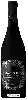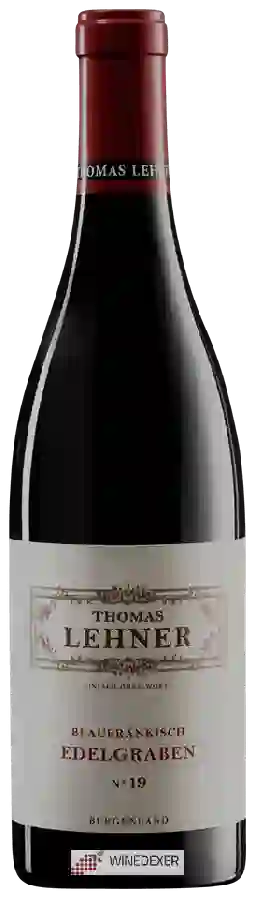
Winery Thomas LehnerNo. 19 Blaufränkisch Edelgraben
 Red wine


In the mouth this red wine is a powerful with a nice balance between acidity and tannins.
This wine generally goes well with poultry, beef or pasta.
Taste structure of the No. 19 Blaufränkisch Edelgraben from the Winery Thomas Lehner
Light | Bold | |
Smooth | Tannic | |
Dry | Sweet | |
Soft | Acidic |
In the mouth the No. 19 Blaufränkisch Edelgraben of Winery Thomas Lehner in the region of Weinland is a powerful with a nice balance between acidity and tannins.
Food and wine pairings with No. 19 Blaufränkisch Edelgraben
Pairings that work perfectly with No. 19 Blaufränkisch Edelgraben



Original food and wine pairings with No. 19 Blaufränkisch Edelgraben
The No. 19 Blaufränkisch Edelgraben of Winery Thomas Lehner matches generally quite well with dishes of beef, pasta or poultry such as recipes of venison leg in casserole, spaghetti cacio e pepe or cantonese rice.
Details and technical informations about Winery Thomas Lehner's No. 19 Blaufränkisch Edelgraben.
Discover the grape variety: Sultanine
Most certainly finding its first origins in Persia, today Iran. It is registered in the Official Catalogue of table grape varieties list A1. Note that the variety gora chirine, also finding its first origins in Iran (Azerbaijan), is a mutation of the Sultanine, its berries of white or pink color being slightly larger.
Last vintages of this wine
The best vintages of No. 19 Blaufränkisch Edelgraben from Winery Thomas Lehner are 2012, 0
Informations about the Winery Thomas Lehner
The Winery Thomas Lehner is one of of the world's greatest estates. It offers 16 wines for sale in the of Burgenland to come and discover on site or to buy online.

The wine region of Burgenland
Burgenland is a large wine-producing region on the eastern border of Austria. Despite the country's image as the producer of some of the world's finest white wines, Austria is also home to a thriving red wine culture: Burgenland, with its sunny, continental summers, is the country's key red wine region, with its wines based mainly on the Blaufränkisch and Zweigelt grape varieties. Sweet, botrytized wines are also a specialty of the region, particularly in the Terroir surrounding the Neusiedlersee lake. The region occupies a narrow strip of land that runs from the Danube River down to Steiermark in the South.
The wine region of Weinland
Weinviertel DAC – whose name translates as "wine quarter" – is an appellation in Niederösterreich (Lower Austria). It is by far the largest Districtus Austriae Controllatus wine region in Austria. It was also the first Austrian wine region to be given that title, in 2002, with a DAC Reserve designation added in 2009. The designation applies only to white wines from the Grüner Veltliner Grape variety.
The word of the wine: Maturing (champagne)
After riddling, the bottles are stored on "point", upside down, with the neck of one bottle in the bottom of the other. The duration of this maturation is very important: in contact with the dead yeasts, the wine takes on subtle aromas and gains in roundness and fatness. A brut without year must remain at least 15 months in the cellar after bottling, a vintage 36 months.