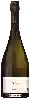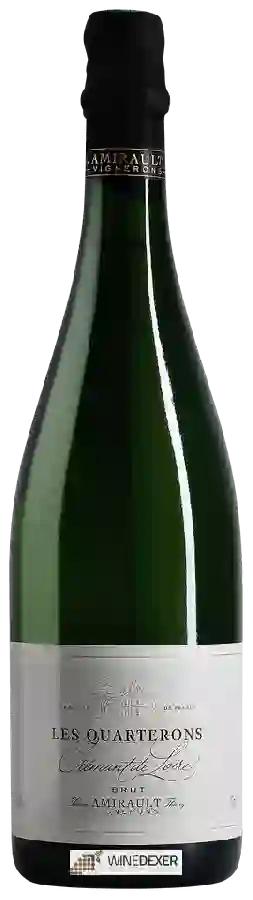
Domaine AmiraultLes Quarterons Crémant de Loire Brut
 Sparkling wine



This wine is a blend of 3 varietals which are the Cabernet franc, the Chardonnay and the Chenin blanc.
In the mouth this sparkling wine is a powerful with a nice vivacity and a fine and pleasant bubble.
This wine generally goes well with poultry, appetizers and snacks or lean fish.
The Les Quarterons Crémant de Loire Brut of the Domaine Amirault is in the top 20 of wines of Crémant de Loire.

Taste structure of the Les Quarterons Crémant de Loire Brut from the Domaine Amirault
Light | Bold | |
Soft | Acidic | |
Gentle | Fizzy |
In the mouth the Les Quarterons Crémant de Loire Brut of Domaine Amirault in the region of Loire Valley is a powerful with a nice vivacity and a fine and pleasant bubble.
Wine flavors and olphactive analysis



On the nose the Les Quarterons Crémant de Loire Brut of Domaine Amirault in the region of Loire Valley often reveals types of flavors of citrus, apples or green apple and sometimes also flavors of lemon, honey or yeast.
Food and wine pairings with Les Quarterons Crémant de Loire Brut
Pairings that work perfectly with Les Quarterons Crémant de Loire Brut



Original food and wine pairings with Les Quarterons Crémant de Loire Brut


The Les Quarterons Crémant de Loire Brut of Domaine Amirault matches generally quite well with dishes of shellfish, poultry or appetizers and snacks such as recipes of rougaille tomatoes (madagascar), basque chicken with chorizo or tuna spread.
Details and technical informations about Domaine Amirault's Les Quarterons Crémant de Loire Brut.
Discover the grape variety: Cabernet franc
Supple, fragrant reds with fine tannins and vibrant freshness, showing raspberry, violet, green pepper, pencil lead and gentle spice aromas. Star of the Loire as a single variety (Chinon, Bourgueil, Saumur-Champigny) and of the right bank of Bordeaux in blends (Cheval Blanc at 60%). Also in semi-dry Anjou rosés. A historic Bordeaux variety, parent of Cabernet-Sauvignon, Merlot and Carmenère.
Informations about the Domaine Amirault
The Domaine Amirault is one of of the world's greatest estates. It offers 21 wines for sale in the of Crémant de Loire to come and discover on site or to buy online.

The wine region of Crémant de Loire
Loire AOC for traditional-method sparkling wines (1975), a refined alternative to Champagne in Anjou, Saumur, Touraine. Fine, fresh bubbles with signature notes of green apple, pear, white flowers, brioche and a honeyed touch, a taut and thirst-quenching palate. Chenin Blanc as the base of Loire expression, complemented by round Chardonnay, Cabernet Franc (raspberry roses), Pinot Noir, Grolleau, Pineau d'Aunis. Hand-harvested, aged min.
The wine region of Loire Valley
Kingdom of lively, dry whites and fine sparklers. Mineral, taut Sauvignon Blanc (Sancerre, Pouilly-Fumé) with citrus and gunflint notes. Multiform Chenin Blanc (Vouvray, Savennières, Layon): straight dry, floral off-dry or noble sweet honey-quince. Saline, iodised Muscadet (Melon B.
The word of the wine: Basic wine
Dry, still wine intended for the production of sparkling wines (champagne, crémants, etc.). The basic wines undergo a second fermentation in the bottle for the production of carbon dioxide, and therefore of bubbles.