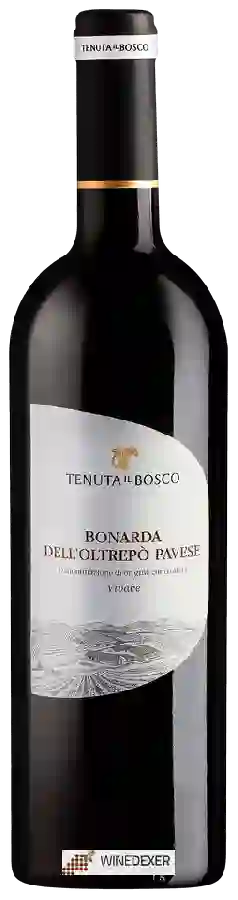
Winery Tenuta Il BoscoVivace Bonarda dell'Oltrepò Pavese
 Red wine



In the mouth this red wine is a powerful.
This wine generally goes well with beef, game (deer, venison) or lamb.
Taste structure of the Vivace Bonarda dell'Oltrepò Pavese from the Winery Tenuta Il Bosco
Light | Bold | |
Smooth | Tannic | |
Dry | Sweet | |
Soft | Acidic |
In the mouth the Vivace Bonarda dell'Oltrepò Pavese of Winery Tenuta Il Bosco in the region of Lombardia is a powerful.
Food and wine pairings with Vivace Bonarda dell'Oltrepò Pavese
Pairings that work perfectly with Vivace Bonarda dell'Oltrepò Pavese



Original food and wine pairings with Vivace Bonarda dell'Oltrepò Pavese

The Vivace Bonarda dell'Oltrepò Pavese of Winery Tenuta Il Bosco matches generally quite well with dishes of beef, pasta or lamb such as recipes of beef tongue with vegetables and madeira sauce, express seafood spaghetti or saddle of lamb stuffed with chicken breast and basil.
Details and technical informations about Winery Tenuta Il Bosco's Vivace Bonarda dell'Oltrepò Pavese.
Discover the grape variety: Bronner
An interspecific cross between merzling and rondo obtained in 1975 by Norbert Becker of the Freiburg Research Institute in Germany. It has the particularity of having only one gene for resistance to mildew and powdery mildew. However, the I.N.R.A. Bordeaux Sciences Agro has since noted a loss of efficiency on mildew due to a bypass. It can be found in Denmark, the Netherlands, Germany, Belgium, Italy, England, etc. It is not very widespread today and is almost unknown in France. It should not be confused with another variety of the same name, which comes from a Pinot Blanc seedling, also obtained in Germany by Johann Philipp Bronner.
Last vintages of this wine
The best vintages of Vivace Bonarda dell'Oltrepò Pavese from Winery Tenuta Il Bosco are 2010, 2017, 2016, 2012 and 2019.
Informations about the Winery Tenuta Il Bosco
The Winery Tenuta Il Bosco is one of of the world's greatest estates. It offers 19 wines for sale in the of Bonarda dell'Oltrepo Pavese to come and discover on site or to buy online.

The wine region of Bonarda dell'Oltrepo Pavese
The wine region of Bonarda dell'Oltrepo Pavese is located in the region of Oltrepò Pavese of Lombardie of Italy. Wineries and vineyards like the Domaine Fattoria Cabanon or the Domaine Castello di Luzzano produce mainly wines red and sparkling. The most planted grape varieties in the region of Bonarda dell'Oltrepo Pavese are Cardinal, they are then used in wines in blends or as a single variety. On the nose of Bonarda dell'Oltrepo Pavese often reveals types of flavors of black fruit, red fruit or non oak and sometimes also flavors of earth, oak or spices.
The wine region of Lombardia
Lombardy is one of Italy's largest and most populous regions, located in the north-central Part of the country. It's home to a handful of popular and well-known wine styles, including the Bright, cherry-scented Valtellina and the high-quality Sparkling wines Franciacorta and Oltrepo Pavese Metodo Classico. Lombardy is Italy's industrial powerhouse, with the country's second largest city (Milan) as its regional capital. Despite this, the region has vast tracts of unspoiled countryside, home to many small wineries that produce a significant portion of the region's annual wine production of 1.
The word of the wine: Frank
Said of a wine that is open and delivers itself immediately, and whose clarity excludes any defect.