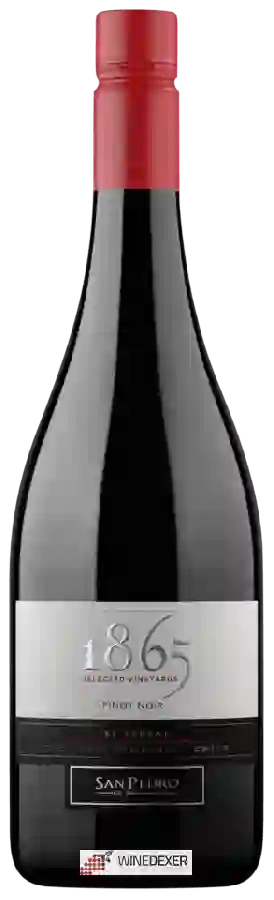
Winery San Pedro1865 Selected Vineyards Pinot Noir
 Red wine



In the mouth this red wine is a powerful.
This wine generally goes well with poultry, beef or veal.
Taste structure of the 1865 Selected Vineyards Pinot Noir from the Winery San Pedro
Light | Bold | |
Smooth | Tannic | |
Dry | Sweet | |
Soft | Acidic |
In the mouth the 1865 Selected Vineyards Pinot Noir of Winery San Pedro in the region of Coquimbo is a powerful.
Wine flavors and olphactive analysis



On the nose the 1865 Selected Vineyards Pinot Noir of Winery San Pedro in the region of Coquimbo often reveals types of flavors of non oak, earth or oak.
Food and wine pairings with 1865 Selected Vineyards Pinot Noir
Pairings that work perfectly with 1865 Selected Vineyards Pinot Noir



Original food and wine pairings with 1865 Selected Vineyards Pinot Noir

The 1865 Selected Vineyards Pinot Noir of Winery San Pedro matches generally quite well with dishes of beef, veal or game (deer, venison) such as recipes of authentic bolognese sauce (ragù di carne), veal simmered with vegetables or venison leg in casserole.
Details and technical informations about Winery San Pedro's 1865 Selected Vineyards Pinot Noir.
Discover the grape variety: Pinot noir
Pinot noir is an important red grape variety in Burgundy and Champagne, and its reputation is well known! Great wines such as the Domaine de la Romanée Conti elaborate their wines from this famous grape variety, and make it a great variety. When properly vinified, pinot noit produces red wines of great finesse, with a wide range of aromas depending on its advancement (fruit, undergrowth, leather). it is also the only red grape variety authorized in Alsace. Pinot Noir is not easily cultivated beyond our borders, although it has enjoyed some success in Oregon, the United States, Australia and New Zealand.
Last vintages of this wine
The best vintages of 1865 Selected Vineyards Pinot Noir from Winery San Pedro are 2017, 2016, 0, 2018
Informations about the Winery San Pedro
The Winery San Pedro is one of of the world's great estates. It offers 188 wines for sale in the of Elqui Valley to come and discover on site or to buy online.

The wine region of Elqui Valley
The Elqui Valley wine region is located 400 kilometers (250mi) North of the Chilean capital, Central-valley/maipo-valley/santiago">Santiago, at the very southern edge of the Atacama Desert. Its latitude of 29° makes it Chile's northernmost wine region, for now at least; the country's determined wine pioneers are now setting their sights as far north as the Atacama. Traditionally the region focused exclusively on producing Chile's trademark brandy, Pisco, but today Elqui Valley vineyards are producing Bright, intensely Aromatic wines, most notably from Sauvignon Blanc and Syrah. As might be expected in an arid, largely uninhabited region surrounded by desert, the valley is hot and Dry making irrigation essential in all vineyards here.
The wine region of Coquimbo
The Elqui Valley wine region is located 400 kilometers (250mi) North of the Chilean capital, Central-valley/maipo-valley/santiago">Santiago, at the very southern edge of the Atacama Desert. Its latitude of 29° makes it Chile's northernmost wine region, for now at least; the country's determined wine pioneers are now setting their sights as far north as the Atacama. Traditionally the region focused exclusively on producing Chile's trademark brandy, Pisco, but today Elqui Valley vineyards are producing Bright, intensely Aromatic wines, most notably from Sauvignon Blanc and Syrah. As might be expected in an arid, largely uninhabited region surrounded by desert, the valley is hot and Dry making irrigation essential in all vineyards here.
The word of the wine: Short
Said of a wine that leaves little trace in the mouth after tasting (also called "short in the mouth").