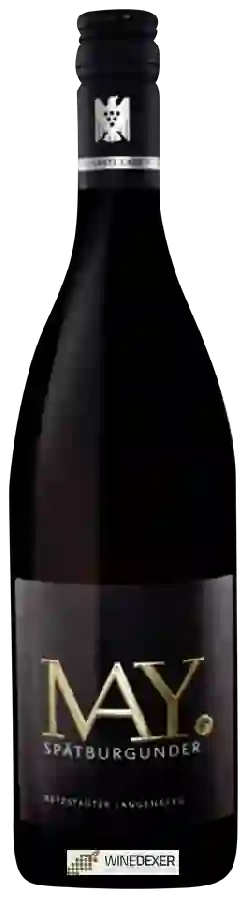
Winery Rudolf MaySpätburgunder Retzstadter Langenberg
 Red wine



In the mouth this red wine is a with a nice freshness.
This wine generally goes well with poultry, beef or veal.

Taste structure of the Spätburgunder Retzstadter Langenberg from the Winery Rudolf May
Light | Bold | |
Smooth | Tannic | |
Dry | Sweet | |
Soft | Acidic |
In the mouth the Spätburgunder Retzstadter Langenberg of Winery Rudolf May in the region of Franken is a with a nice freshness.
Wine flavors and olphactive analysis



On the nose the Spätburgunder Retzstadter Langenberg of Winery Rudolf May in the region of Franken often reveals types of flavors of earth, microbio or oak and sometimes also flavors of red fruit.
Food and wine pairings with Spätburgunder Retzstadter Langenberg
Pairings that work perfectly with Spätburgunder Retzstadter Langenberg



Original food and wine pairings with Spätburgunder Retzstadter Langenberg

The Spätburgunder Retzstadter Langenberg of Winery Rudolf May matches generally quite well with dishes of beef, veal or game (deer, venison) such as recipes of tata simone's dumplings, veal escalope (piccata milanese) or duck aiguillettes with basalmic.
Details and technical informations about Winery Rudolf May's Spätburgunder Retzstadter Langenberg.
Discover the grape variety: Canaiolo
Supple and delicate reds with a clear ruby hue, smooth tannins and an airy palate, featuring signature aromas of plum, violet, cherry and gentle spices. Brings roundness and fruit to blends. Long the companion of Sangiovese in the historic Chianti DOCG, it produces approachable Tuscan wines. Today seeing renewed interest as a single variety for more delicate artisan cuvées. Emblematic autochthonous black variety from Tuscany.
Last vintages of this wine
The best vintages of Spätburgunder Retzstadter Langenberg from Winery Rudolf May are 2016, 2017, 0, 2015
Informations about the Winery Rudolf May
The Winery Rudolf May is one of of the world's great estates. It offers 45 wines for sale in the of Franken to come and discover on site or to buy online.

The wine region of Franken
Homeland of German Silvaner: dry, straight, mineral and lively whites with notes of green apple, citrus, fresh herbs and a saline touch, planted here for over 350 years (1,500 ha, a quarter of the vineyard). Also supple, floral Müller-Thurgau, taut Riesling, aromatic Bacchus. Some discreet reds (Spätburgunder). 6,040 ha in Bavaria along the Main around Würzburg, red sandstone and shell-limestone soils.
The word of the wine: Oxidized
Altered by oxidation.