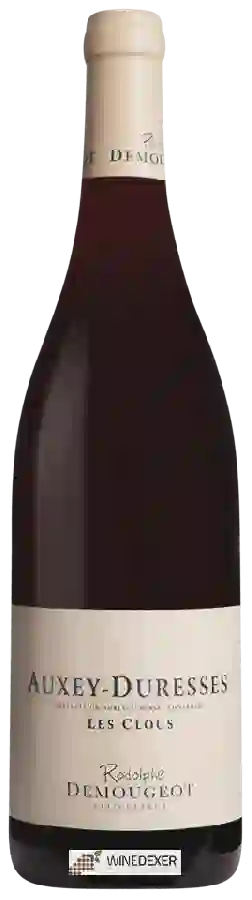
Winery Rodolphe DemougeotAuxey-Duresses Les Clous
 Red wine


In the mouth this red wine is a with a nice freshness.
This wine generally goes well with poultry, beef or veal.

Taste structure of the Auxey-Duresses Les Clous from the Winery Rodolphe Demougeot
Light | Bold | |
Smooth | Tannic | |
Dry | Sweet | |
Soft | Acidic |
In the mouth the Auxey-Duresses Les Clous of Winery Rodolphe Demougeot in the region of Burgundy is a with a nice freshness.
Wine flavors and olphactive analysis


On the nose the Auxey-Duresses Les Clous of Winery Rodolphe Demougeot in the region of Burgundy often reveals types of flavors of oak, red fruit.
Food and wine pairings with Auxey-Duresses Les Clous
Pairings that work perfectly with Auxey-Duresses Les Clous



Original food and wine pairings with Auxey-Duresses Les Clous

The Auxey-Duresses Les Clous of Winery Rodolphe Demougeot matches generally quite well with dishes of beef, veal or game (deer, venison) such as recipes of baked marrow bones, stuffed veal breast or mixed paella valenciana.
Details and technical informations about Winery Rodolphe Demougeot's Auxey-Duresses Les Clous.
Discover the grape variety: Pinot noir
Elegant reds, light in colour with silky tannins, showing strawberry, cherry and raspberry aromas, evolving to forest floor, mushroom and spice with age. Fresh acidity, delicate finish. Star of the Côte d'Or (Romanée-Conti, Chambertin, Volnay), pillar of Champagne (Blanc de Noirs) and signature of Oregon, Central Otago and Sonoma Coast. An early-ripening Burgundian variety, one of the world's greatest.
Last vintages of this wine

The best vintages of Auxey-Duresses Les Clous from Winery Rodolphe Demougeot are 2008, 2015, 2017, 2013
Informations about the Winery Rodolphe Demougeot
The Winery Rodolphe Demougeot is one of of the world's greatest estates. It offers 19 wines for sale in the of Auxey-Duresses to come and discover on site or to buy online.

The wine region of Auxey-Duresses
Discreet Cote de Beaune village west of Meursault: Pinot Noir reigns in red (~2/3) — ruby robe with notes of blueberry, blackcurrant, blackberry, redcurrant, raspberry, cherry, peony and smoke, signature tannic structure more solid and masculine evoking a light Pommard, ageing 5-10 years. Chardonnay as refined white complement (pale straw, fresh almond, hawthorn, citrus, reinette, biscuit and fine minerality). AOC (1937), 9 Premiers Crus, marl-limestone south slopes.
The wine region of Burgundy
Absolute reference for great terroir wines: opulent, mineral Chardonnay in whites (chiselled Chablis, buttery Meursault, majestic Montrachet), fine and silky Pinot Noir in reds (full-bodied Gevrey, structured Pommard, delicate Volnay). Exceptional age-worthy wines with complex notes - red fruits, undergrowth, butter, hazelnut. Some lively Aligoté and light Gamay (Mâconnais). 29,500 ha, 84 tiered AOCs (Régionale, Village, 1er Cru, Grand Cru), 1,247 UNESCO Climats.
The word of the wine: Over-ripeness
Characteristic of grapes harvested late, rich in sugar, which give wines often mellow and marked by candied aromas.


