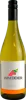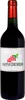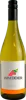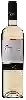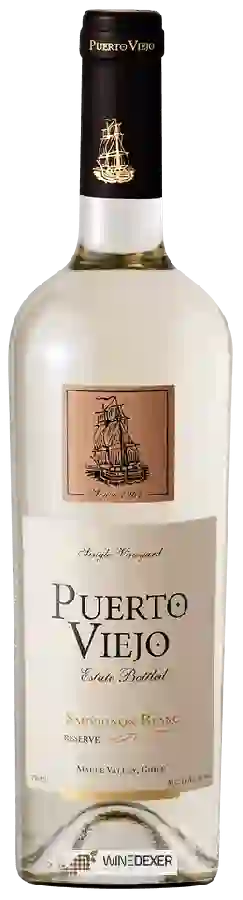
Winery Puerto ViejoReserve Sauvignon Blanc
 White wine


In the mouth this white wine is a with a nice freshness.
This wine generally goes well with vegetarian, shellfish or goat cheese.

Taste structure of the Reserve Sauvignon Blanc from the Winery Puerto Viejo
Light | Bold | |
Dry | Sweet | |
Soft | Acidic |
In the mouth the Reserve Sauvignon Blanc of Winery Puerto Viejo in the region of Central Valley is a with a nice freshness.
Wine flavors and olphactive analysis


On the nose the Reserve Sauvignon Blanc of Winery Puerto Viejo in the region of Central Valley often reveals types of flavors of vegetal, tree fruit.
Food and wine pairings with Reserve Sauvignon Blanc
Pairings that work perfectly with Reserve Sauvignon Blanc



Original food and wine pairings with Reserve Sauvignon Blanc
The Reserve Sauvignon Blanc of Winery Puerto Viejo matches generally quite well with dishes of shellfish, vegetarian or goat cheese such as recipes of paella from an old spanish grandmother..., light tuna-tomato quiche (without cream) or 4 seasons pizza my way.
Details and technical informations about Winery Puerto Viejo's Reserve Sauvignon Blanc.
Discover the grape variety: Calabrese di Montenuovo
Light, simple reds with a clear ruby robe, smooth tannins and an airy palate with preserved acidity. Signature aromas of red fruits (cherry, raspberry), soft spices and fresh floral notes from Campania. Rustic, airy profile, nearly extinct. Conserved in heritage vineyards for its exceptional genetic and patrimonial value. Rare native Italian black grape from Campania, genetically identified as the mother of Sangiovese (father: Ciliegiolo).
Last vintages of this wine

The best vintages of Reserve Sauvignon Blanc from Winery Puerto Viejo are 2010, 2017, 2014, 2012 and 2018.
Informations about the Winery Puerto Viejo
The Winery Puerto Viejo is one of of the world's greatest estates. It offers 15 wines for sale in the of Maule Valley to come and discover on site or to buy online.

The wine region of Maule Valley
Historic cradle of Chilean viticulture (16th century). Quality revival around old-vine Carignan (70+ years): dense, deep reds with notes of blackberry, candied plum, spices and fine tannins, a unique expression. Sturdy Cabernet Sauvignon, supple Carménère (ripe pepper, black fruits), juicy Côt (Malbec), round Merlot. Some sharp Sauvignon Blanc.
The wine region of Central Valley
Heart of modern Chilean wine: structured, sunny reds, dense, blackcurranty Cabernet Sauvignon from Maipo (Chilean cradle of the grape), signature Carménère with notes of ripe pepper, black fruit and sweet spices from Colchagua, supple Merlot and deep Syrah. Round Chardonnay whites and lively, sharp Sauvignon. Mediterranean climate, 400 km between Andes and Pacific. Star sub-regions: Maipo, Cachapoal, Colchagua, Curicó, Maule.
The word of the wine: Cup (size in)
Specific to the Mediterranean vineyard, this short pruning which opens the stock in the shape of a corolla offers a good resistance to violent winds but does not allow any mechanization of the vine work.