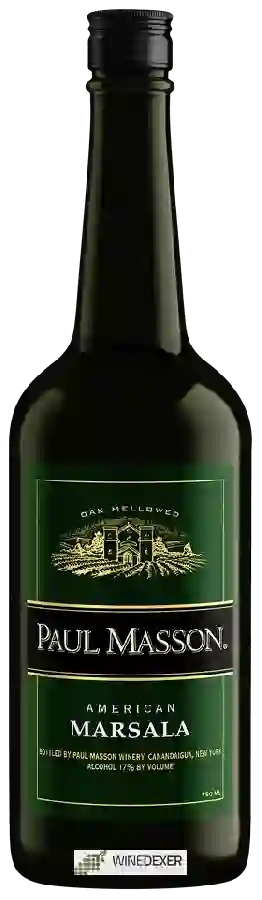
Winery Paul MassonMarsala
 Natural sweet wine


This wine is composed of 100% of the grape variety Grillo.
This wine generally goes well with
Wine flavors and olphactive analysis



On the nose the Marsala of Winery Paul Masson in the region of California often reveals types of flavors of microbio, oak or spices and sometimes also flavors of dried fruit, tropical fruit.
Details and technical informations about Winery Paul Masson's Marsala.
Discover the grape variety: Grillo
A very ancient grape variety still grown today in western Sicily. Very often associated with catarratto and inzolia, it produces the famous Marsala liqueur wine. It is also increasingly being vinified as a single variety and produces excellent dry wines full of freshness and fruitiness. Grillo is believed to be the result of an intra-fertile cross between catarratto and Muscat of Alexandria or zibibbo, obtained in 1869 by Antonino Mendola. It is represented by two biotypes that can be easily recognized, but it seems that winegrowers attach little importance to them. Little known in other Italian regions - in Liguria it is known as "rossese bianco" - it can also be found in Australia and South Africa. It is not widely grown in France, although it is interesting because of its ability to withstand hot climates and drought, and to ripen quite late.
Last vintages of this wine
The best vintages of Marsala from Winery Paul Masson are 0
Informations about the Winery Paul Masson
The Winery Paul Masson is one of of the world's great estates. It offers 28 wines for sale in the of California to come and discover on site or to buy online.

The wine region of California
California is the largest and most important wine region in the United States. It represents the southern two-thirds (850 miles or 1,370 kilometers) of the country's west coast. (Oregon and Washington make up the rest. ) The state also spans nearly 10 degrees of latitude.
The word of the wine: Alcoholic fermentation
Transformation of sugars into alcohol under the effect of yeast. These yeasts exist in their natural state in the vineyards and in the cellars. Artificial seeding with selected yeasts is however very often practiced.