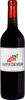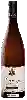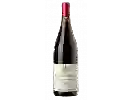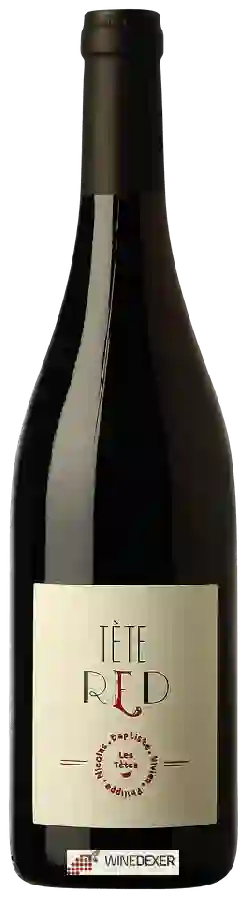
Winery Les TètesTète Red
 Red wine



This wine is a blend of 2 varietals which are the Cabernet franc and the Grolleau.
This wine generally goes well with pork, poultry or beef.

Wine flavors and olphactive analysis






On the nose the Tète Red of Winery Les Tètes in the region of Loire Valley often reveals types of flavors of cherry, earthy or red fruit and sometimes also flavors of strawberries, plum or raspberry.
Food and wine pairings with Tète Red
Pairings that work perfectly with Tète Red



Original food and wine pairings with Tète Red


The Tète Red of Winery Les Tètes matches generally quite well with dishes of beef, pork or game (deer, venison) such as recipes of sweet and sour turkish dumpling soup (eksili köfte), pork cheeks confit in cider or rabbit with leeks.
Details and technical informations about Winery Les Tètes's Tète Red.
Discover the grape variety: Cabernet franc
Supple, fragrant reds with fine tannins and vibrant freshness, showing raspberry, violet, green pepper, pencil lead and gentle spice aromas. Star of the Loire as a single variety (Chinon, Bourgueil, Saumur-Champigny) and of the right bank of Bordeaux in blends (Cheval Blanc at 60%). Also in semi-dry Anjou rosés. A historic Bordeaux variety, parent of Cabernet-Sauvignon, Merlot and Carmenère.
Last vintages of this wine
The best vintages of Tète Red from Winery Les Tètes are 2017, 2015, 2014
Informations about the Winery Les Tètes
The Winery Les Tètes is one of of the world's greatest estates. It offers 20 wines for sale in the of Loire Valley to come and discover on site or to buy online.

The wine region of Loire Valley
Kingdom of lively, dry whites and fine sparklers. Mineral, taut Sauvignon Blanc (Sancerre, Pouilly-Fumé) with citrus and gunflint notes. Multiform Chenin Blanc (Vouvray, Savennières, Layon): straight dry, floral off-dry or noble sweet honey-quince. Saline, iodised Muscadet (Melon B.
The word of the wine: Mercaptan
Organic compound resulting from the combination of alcohol and sulphide (H2S) producing an unpleasant odour reminiscent of town gas and rotten eggs.