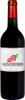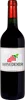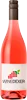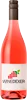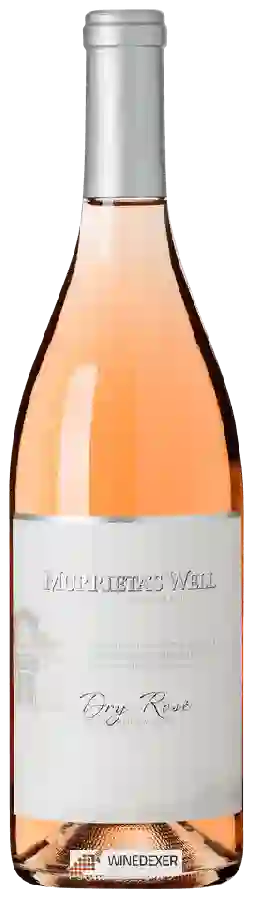
Winery Murrieta's WellDry Rosé
 Pink wine


This wine is composed of 100% of the grape variety Counoise.
This wine generally goes well with beef and mature and hard cheese.
The Dry Rosé of the Winery Murrieta's Well is in the top 90 of wines of Livermore Valley.

Wine flavors and olphactive analysis


On the nose the Dry Rosé of Winery Murrieta's Well in the region of California often reveals types of flavors of earth, microbio or tree fruit and sometimes also flavors of citrus fruit, red fruit.
Food and wine pairings with Dry Rosé
Pairings that work perfectly with Dry Rosé


Original food and wine pairings with Dry Rosé
The Dry Rosé of Winery Murrieta's Well matches generally quite well with dishes of beef or mature and hard cheese such as recipes of baked lasagna or franco-comtois beef.
Details and technical informations about Winery Murrieta's Well's Dry Rosé.
Discover the grape variety: Counoise
Supple and fresh reds with a clear ruby colour, melted tannins and preserved acidity despite the sun, on aromas of strawberry, raspberry, red cherry, white pepper, garrigue and spiced notes. Airy and thirst-quenching palate. A traditional component of Châteauneuf-du-Pape AOC (one of the 13 authorised varieties), it brings freshness, finesse and aromatic complexity to southern blends of Côtes-du-Rhône and Languedoc. Native Rhône variety, very late-ripening.
Last vintages of this wine

The best vintages of Dry Rosé from Winery Murrieta's Well are 2015, 2017, 0, 2016 and 2018.
Informations about the Winery Murrieta's Well
The Winery Murrieta's Well is one of of the world's great estates. It offers 38 wines for sale in the of Livermore Valley to come and discover on site or to buy online.

The wine region of Livermore Valley
Historic Bay Area AVA (first US varietal bottling of Chardonnay, Wente clone ~80% of Californian Chardonnay): signature Cabernet Sauvignon dominant (33%) and Chardonnay (22%) as kings, followed by Merlot, Petite Sirah and Syrah. Cabernet Franc and Sauvignon Blanc named signatures in 2025. Warm Winkler III climate moderated by San Francisco Bay, gravel, limestone and clay soils. Historic Californian Bordeaux and Rhône identity.
The wine region of California
Powerful, sunny reds: dense Napa Cabernet Sauvignon (blackcurrant, chocolate, tobacco, ample tannins), spicy, jammy Zinfandel from the Sierra Foothills, silky red-fruited Pinot Noir on the cool coast (Sonoma, Russian River, Central Coast). Opulent, buttery Chardonnay, notes of yellow fruit and vanilla. Varied climate, from the hot interior to the Pacific-cooled coast. 80% of US production, 139 AVAs including Napa (1st AVA, 1981).
The word of the wine: Oenologist
Specialist in wine-making techniques. It is a profession and not a passion: one can be an oenophile without being an oenologist (and the opposite too!). Formerly attached to the Faculty of Pharmacy, oenology studies have become independent and have their own university course. Learning to make wine requires a good chemical background but also, increasingly, a good knowledge of the plant. Some oenologists work in laboratories (analysis). Others, the consulting oenologists, work directly in the properties.