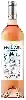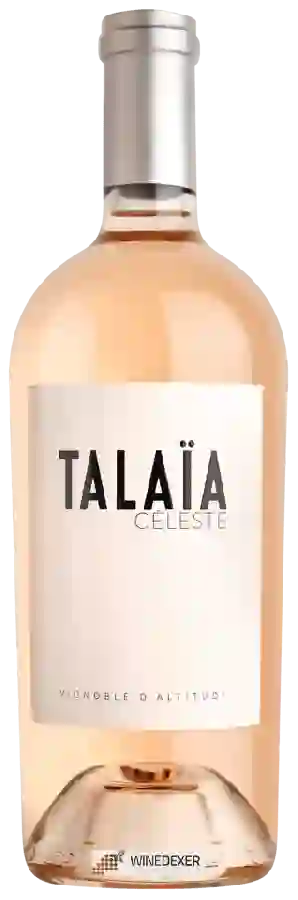
Winery Mas TalaïaCèleste Rosé
 Pink wine


In the mouth this pink wine is a with a nice freshness.
This wine generally goes well with vegetarian, appetizers and snacks or lean fish.
Taste structure of the Cèleste Rosé from the Winery Mas Talaïa
Light | Bold | |
Dry | Sweet | |
Soft | Acidic |
In the mouth the Cèleste Rosé of Winery Mas Talaïa in the region of Languedoc-Roussillon is a with a nice freshness.
Food and wine pairings with Cèleste Rosé
Pairings that work perfectly with Cèleste Rosé



Original food and wine pairings with Cèleste Rosé


The Cèleste Rosé of Winery Mas Talaïa matches generally quite well with dishes of pasta, vegetarian or appetizers and snacks such as recipes of salmon and spinach lasagna, mushroom, bacon and gruyere quiche or rillettes of sardines.
Details and technical informations about Winery Mas Talaïa's Cèleste Rosé.
Discover the grape variety: Roi des noirs
Interspecific crossing between 29 Seibel (70 jeager x Vitis Vinifera unknown) and the danugue made by Eugène Contassot, who would have given the seeds of the harvested grapes to Albert Seibel (1844-1936). The King of the Blacks has been widely cultivated, particularly in southwestern France and in the center-west, where we have found and photographed it. It was used several times as a sire by Albert Seibel, rubilande or 11803 Seibel is a good example.
Last vintages of this wine
The best vintages of Cèleste Rosé from Winery Mas Talaïa are 2019, 0
Informations about the Winery Mas Talaïa
The Winery Mas Talaïa is one of of the world's greatest estates. It offers 3 wines for sale in the of Côtes du Roussillon to come and discover on site or to buy online.

The wine region of Côtes du Roussillon
Côtes du Roussillon is an appellation contrôlée for red, white and rosé wines from the Roussillon wine region in southern France. It covers the eastern half of the administrative district of the Pyrénées-Orientales, on the eastern edge of the Pyrenees. The western half of the Pyrenees-Orientales is simply too mountainous for effective viticulture. In the Côtes du Roussillon wine-growing area is the Aspres sub-region.
The wine region of Languedoc-Roussillon
Languedoc (formerly Coteaux du Languedoc) is a key appellation used in the Languedoc-Roussillon wine region of southern France. It covers Dry table wines of all three colors (red, white and rosé) from the entire region, but leaves Sweet and Sparkling wines to other more specialized appellations. About 75% of all Languedoc wines are red, with the remaining 25% split roughly down the middle between whites and rosés. The appellation covers most of the Languedoc region and almost a third of all the vineyards in France.
The word of the wine: Natural sweet wine
Wine obtained by mutage with wine alcohol of the must in the course of fermentation, from the Muscat, Grenache, Macabeu and Malvoisie grape varieties, and corresponding to strict conditions of production, richness and elaboration.