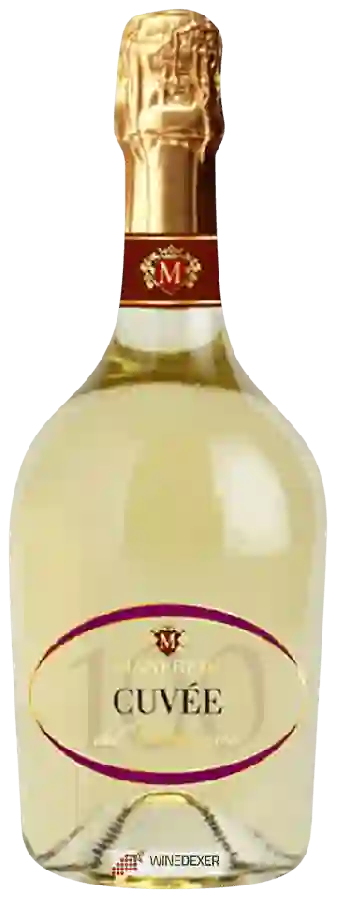
Winery ManfrediCuvée del Centenario
 White wine



In the mouth this white wine is a powerful.
This wine generally goes well with lean fish, shellfish or mature and hard cheese.
Taste structure of the Cuvée del Centenario from the Winery Manfredi
Light | Bold | |
Dry | Sweet | |
Soft | Acidic |
In the mouth the Cuvée del Centenario of Winery Manfredi in the region of Piedmont is a powerful.
Food and wine pairings with Cuvée del Centenario
Pairings that work perfectly with Cuvée del Centenario



Original food and wine pairings with Cuvée del Centenario


The Cuvée del Centenario of Winery Manfredi matches generally quite well with dishes of pasta, shellfish or mature and hard cheese such as recipes of multicoloured butterfly pasta, clams in white wine or cheese cromesquis.
Details and technical informations about Winery Manfredi's Cuvée del Centenario.
Discover the grape variety: Petit Bouschet
Crossbreeding carried out in 1829 by Louis Bouschet de Bernard (father of Henri Bouschet, also known for his numerous varieties) between the aramon and the teinturier. It was practically multiplied all over the world. Today, it is an extinct grape variety and can only be found in a few private or public collections and conservatories.
Last vintages of this wine
The best vintages of Cuvée del Centenario from Winery Manfredi are 0
Informations about the Winery Manfredi
The Winery Manfredi is one of of the world's great estates. It offers 38 wines for sale in the of Piedmont to come and discover on site or to buy online.

The wine region of Piedmont
Piedmont (Piemonte) holds an unrivalled place among the world's finest wine regions. Located in northwestern Italy, it is home to more DOCG wines than any other Italian region, including such well-known and respected names as Barolo, Barbaresco and Barbera d'Asti. Though famous for its Austere, Tannic, Floral">floral reds made from Nebbiolo, Piedmont's biggest success story in the past decade has been Moscato d'Asti, a Sweet, Sparkling white wine. Piedmont Lies, as its name suggests, at the foot of the Western Alps, which encircle its northern and western sides and form its naturally formidable border with Provence, France.
The word of the wine: Yeast
Micro-organisms at the base of all fermentative processes. A wide variety of yeasts live and thrive naturally in the vineyard, provided that treatments do not destroy them. Unfortunately, their replacement by laboratory-selected yeasts is often the order of the day and contributes to the standardization of the wine. Yeasts are indeed involved in the development of certain aromas.