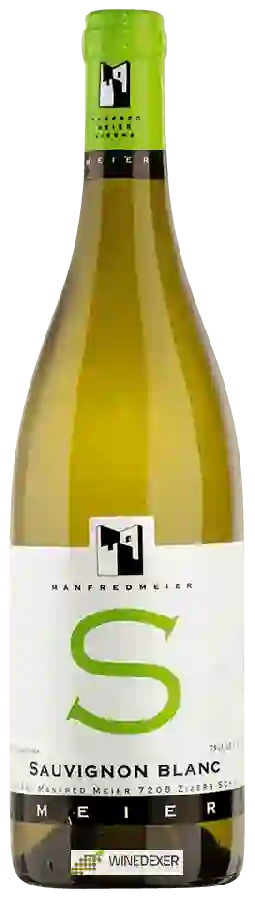
Winery Manfred MeierS Sauvignon Blanc
 White wine



This wine generally goes well with vegetarian, rich fish (salmon, tuna etc) or shellfish.

Food and wine pairings with S Sauvignon Blanc
Pairings that work perfectly with S Sauvignon Blanc



Original food and wine pairings with S Sauvignon Blanc
The S Sauvignon Blanc of Winery Manfred Meier matches generally quite well with dishes of rich fish (salmon, tuna etc), shellfish or vegetarian such as recipes of spinach, smoked salmon and ricotta lasagne, soy and shrimp noodles or light tuna-tomato quiche (without cream).
Details and technical informations about Winery Manfred Meier's S Sauvignon Blanc.
Discover the grape variety: Scheurebe
Aromatic, structured whites with lively acidity and a round mouth, featuring intense aromas of pink grapefruit, blackcurrant, passion fruit, white flowers and muscat notes. Made as aromatic dry wines (Trocken), off-dry (Kabinett, Spätlese) and especially sumptuous botrytised sweet wines (Auslese, Beerenauslese, Trockenbeerenauslese). Grown in Germany (Rheinhessen, Palatinate) and Austria. Created in 1916 by Georg Scheu in Alzey, a Riesling × Bukettrebe cross.
Last vintages of this wine
The best vintages of S Sauvignon Blanc from Winery Manfred Meier are 2013, 2018, 2017, 2014 and 0.
Informations about the Winery Manfred Meier
The Winery Manfred Meier is one of of the world's greatest estates. It offers 15 wines for sale in the of Graubünden to come and discover on site or to buy online.

The wine region of Graubünden
Wine canton of eastern German-speaking Switzerland (Grisons), 423 ha at the heart of the Bündner Herrschaft (Fläsch, Maienfeld, Malans, Jenins). Signature Pinot Noir (Blauburgunder, >70%): reds among the noblest in Switzerland, fine and silky with notes of cherry, raspberry, undergrowth, sweet spices and a limestone mineral touch, delicate tannins - compared to the great Burgundies. Schistous limestone soils, a climate tempered by the foehn (warmest area of German-speaking Switzerland).
The word of the wine: Oenologist
Specialist in wine-making techniques. It is a profession and not a passion: one can be an oenophile without being an oenologist (and the opposite too!). Formerly attached to the Faculty of Pharmacy, oenology studies have become independent and have their own university course. Learning to make wine requires a good chemical background but also, increasingly, a good knowledge of the plant. Some oenologists work in laboratories (analysis). Others, the consulting oenologists, work directly in the properties.