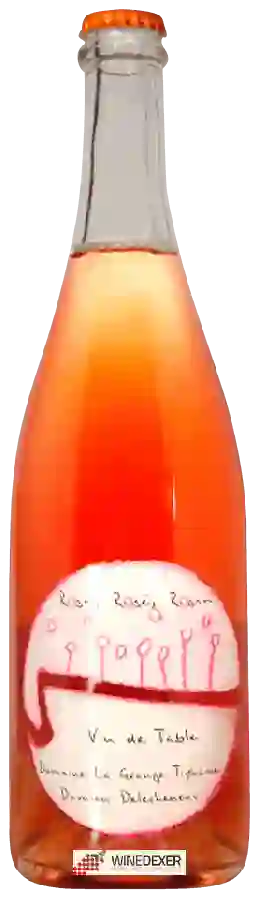
Winery La Grange TiphaineRosa, Rosé, Rosam
 Pink wine


This wine generally goes well with poultry, beef or game (deer, venison).
Wine flavors and olphactive analysis


On the nose the Rosa, Rosé, Rosam of Winery La Grange Tiphaine in the region of Pays d'Oc often reveals types of flavors of cream, cherry or grapefruit and sometimes also flavors of apples, strawberries or raspberry.
Food and wine pairings with Rosa, Rosé, Rosam
Pairings that work perfectly with Rosa, Rosé, Rosam



Original food and wine pairings with Rosa, Rosé, Rosam

The Rosa, Rosé, Rosam of Winery La Grange Tiphaine matches generally quite well with dishes of beef, game (deer, venison) or mature and hard cheese such as recipes of roast pork with pineapple, duck breast with foie gras sauce or three-cheese pie (beaufort, comté, emmental).
Details and technical informations about Winery La Grange Tiphaine's Rosa, Rosé, Rosam.
Discover the grape variety: Pinotage
An intraspecific cross between pinot noir and cinsaut called hermitage, obtained in South Africa in 1925 by Professor Abraham Izak Perold. Since then, it has been propagated in Africa, New Zealand, Australia, the United States (California), Canada, Brazil, Israel, etc. In France, it is practically unknown, although it is registered in the Official Catalogue of Vine Varieties on the A1 list. - Synonymy: none to date (for all the synonyms of the varieties, click here!).
Last vintages of this wine

The best vintages of Rosa, Rosé, Rosam from Winery La Grange Tiphaine are 2019, 2017, 2015, 2013 and 2016.
Informations about the Winery La Grange Tiphaine
The Winery La Grange Tiphaine is one of of the world's greatest estates. It offers 21 wines for sale in the of Vin de Pays to come and discover on site or to buy online.

The wine region of Vin de Pays
Vin de Pays (VDP), the French national equivalent of PGI (Protected Geographical Indication) at the European level, is a quality category of French wines, positioned between Vin de Table (VDT) and Appellation d'Origine Contrôlée (AOC). This layer of the French appellation system was initially introduced in September 1968 by the INAO, the official appellation authority. It underwent several early revisions in the 1970s, followed by substantial changes in September 2000 and again in 2009, when all existing VDT titles were automatically registered with the European Union as PGI. Producers retain the choice of using either the VDP or PGI titles on their labels, or both - in the form "IGP-Vin de Pays".
The wine region of Pays d'Oc
Pays d'Oc is the PGI for red, white and rosé wines that are produced over a wide area of the southern coast of France. The PGI catchment area corresponds roughly to the Languedoc-roussillon">Languedoc-Roussillon wine region, one of the largest wine regions in France. The area covers all wines that are not produced under the strict laws that govern AOC-level appellations in the regions: among them, Corbières, Minervois and the Languedoc appellation itself. The Pays d'Oc PGI is arguably the most important in France, producing the majority of the country's PGI wines.
The word of the wine: Wooded
A set of aromas brought about by ageing in barrels (usually oak). This can be pleasant when, in small doses, it brings a touch of spice, roast or vanilla to an already constructed ensemble. When the violent woodiness dominates the wine, it is quickly tiring. Easily identifiable aromatically, it is sought after (to the point of abuse) by the makers of coarse wines. New World manufacturers and, alas, some French winemakers use oak chips to impart the woody taste, which is tantamount to artificial flavoring.