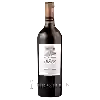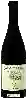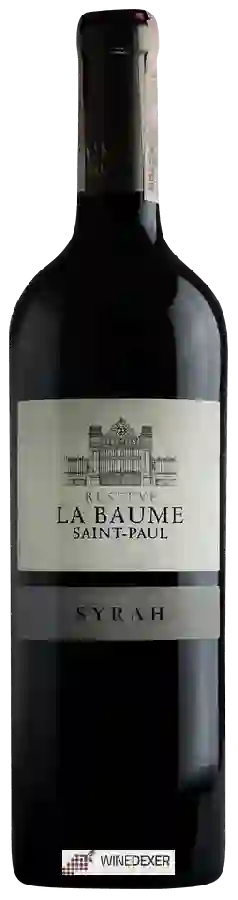
Domaine de la BaumeSyrah Réserve Saint-Paul
 Red wine



In the mouth this red wine is a powerful with a nice balance between acidity and tannins.
This wine generally goes well with beef, veal or pasta.

Taste structure of the Syrah Réserve Saint-Paul from the Domaine de la Baume
Light | Bold | |
Smooth | Tannic | |
Dry | Sweet | |
Soft | Acidic |
In the mouth the Syrah Réserve Saint-Paul of Domaine de la Baume in the region of Languedoc-Roussillon is a powerful with a nice balance between acidity and tannins.
Wine flavors and olphactive analysis




On the nose the Syrah Réserve Saint-Paul of Domaine de la Baume in the region of Languedoc-Roussillon often reveals types of flavors of cherry, tobacco or pepper and sometimes also flavors of non oak, earth or oak.
Food and wine pairings with Syrah Réserve Saint-Paul
Pairings that work perfectly with Syrah Réserve Saint-Paul



Original food and wine pairings with Syrah Réserve Saint-Paul
The Syrah Réserve Saint-Paul of Domaine de la Baume matches generally quite well with dishes of beef, pasta or veal such as recipes of tournedos rossini, pasta with chicken, peppers and mushrooms or veal roast casserole.
Details and technical informations about Domaine de la Baume's Syrah Réserve Saint-Paul.
Discover the grape variety: Timorasso
Structured, complex dry whites with a pale golden robe, an ample palate and a cutting acidity, showing signature aromas of citrus (lemon, grapefruit), yellow fruits (pear, peach), white flowers, honey and hydrocarbon mineral notes (signature, aged-Riesling-like). Fine ageing and cellaring potential. The star of Colli Tortonesi DOC, a successful ampelographic revival in modern Piedmont. An indigenous Piedmontese variety rediscovered in the 1980s by Walter Massa.
Last vintages of this wine
The best vintages of Syrah Réserve Saint-Paul from Domaine de la Baume are 2019, 2018, 2017, 2016 and 2013.
Informations about the Domaine de la Baume
The Domaine de la Baume is one of of the world's great estates. It offers 96 wines for sale in the of Languedoc-Roussillon to come and discover on site or to buy online.

The wine region of Languedoc-Roussillon
Largest single French vineyard, dominated by sunny, generous reds. Spicy Syrah, candied Grenache (ripe fruit, garrigue), structured Carignan, deep Mourvèdre, supple Cinsault. Stars: structured Corbières, Minervois, Faugères, Saint-Chinian; round Côtes-du-Roussillon. Legendary vins doux naturels: Banyuls and Maury (fortified Grenache) with notes of cocoa, fig, prune.
The word of the wine: Ventilation
Aeration is the process of decanting the wine to oxygenate it and thus promote the expression of the aromatic range and the harmony of the flavours.