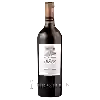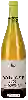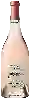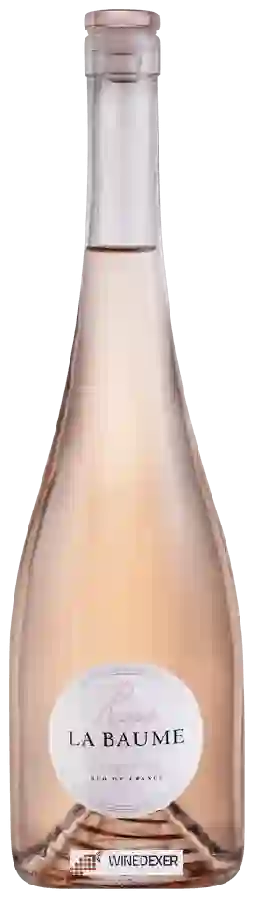
Domaine de la BaumeLa Baume Rosé
 Pink wine



In the mouth this pink wine is a with a nice freshness.
This wine generally goes well with vegetarian, appetizers and snacks or lean fish.
Taste structure of the La Baume Rosé from the Domaine de la Baume
Light | Bold | |
Dry | Sweet | |
Soft | Acidic |
In the mouth the La Baume Rosé of Domaine de la Baume in the region of Languedoc-Roussillon is a with a nice freshness.
Wine flavors and olphactive analysis






On the nose the La Baume Rosé of Domaine de la Baume in the region of Languedoc-Roussillon often reveals types of flavors of citrus, peach or strawberries and sometimes also flavors of raspberry, pear or orange.
Food and wine pairings with La Baume Rosé
Pairings that work perfectly with La Baume Rosé



Original food and wine pairings with La Baume Rosé


The La Baume Rosé of Domaine de la Baume matches generally quite well with dishes of pasta, vegetarian or appetizers and snacks such as recipes of pasta with parmesan cream and ham, nanie's diced ham quiche or salted muffins with bacon and grated cheese.
Details and technical informations about Domaine de la Baume's La Baume Rosé.
Discover the grape variety: Ribier noir
Most certainly originating from the department of Ardeche, more precisely from the region between Aubenas, Privas, Saint Péray, ... . It could also be found in the Galaure valley in the Drôme department as well as in Isère. It is said to be the mother of the raisin, another Ardèche grape variety. Today, Ribier is no longer planted, which means it is almost certain to disappear. It should not be confused with Alphonse Lavallée, which is synonymous with ribier, with marocain or ribier du Maroc, ... .
Last vintages of this wine
The best vintages of La Baume Rosé from Domaine de la Baume are 2018, 2019
Informations about the Domaine de la Baume
The Domaine de la Baume is one of of the world's greatest estates. It offers 96 wines for sale in the of Languedoc to come and discover on site or to buy online.

The wine region of Languedoc
Languedoc (formerly Coteaux du Languedoc) is a key appellation used in the Languedoc-Roussillon wine region of southern France. It covers Dry table wines of all three colors (red, white and rosé) from the entire region, but leaves Sweet and Sparkling wines to other more specialized appellations. About 75% of all Languedoc wines are red, with the remaining 25% split roughly down the middle between whites and rosés. The appellation covers most of the Languedoc region and almost a third of all the vineyards in France.
The wine region of Languedoc-Roussillon
Languedoc (formerly Coteaux du Languedoc) is a key appellation used in the Languedoc-Roussillon wine region of southern France. It covers Dry table wines of all three colors (red, white and rosé) from the entire region, but leaves Sweet and Sparkling wines to other more specialized appellations. About 75% of all Languedoc wines are red, with the remaining 25% split roughly down the middle between whites and rosés. The appellation covers most of the Languedoc region and almost a third of all the vineyards in France.
The word of the wine: VDN
Natural sweet wine. Wine obtained by mutage of the must during fermentation by adding over-finished alcohol at 96 °, produced in the vineyards of Roussillon, Languedoc, Rhone Valley and Corsica.