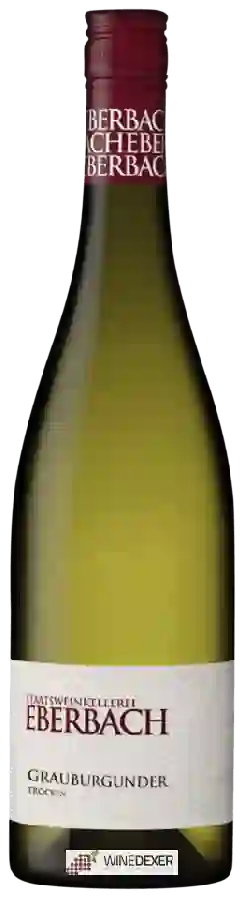
Winery Kloster EberbachGrauburgunder
 White wine



In the mouth this white wine is a powerful.
This wine generally goes well with pork, cured meat or mushrooms.

Taste structure of the Grauburgunder from the Winery Kloster Eberbach
Light | Bold | |
Dry | Sweet | |
Soft | Acidic |
In the mouth the Grauburgunder of Winery Kloster Eberbach in the region of Rheingau is a powerful.
Food and wine pairings with Grauburgunder
Pairings that work perfectly with Grauburgunder



Original food and wine pairings with Grauburgunder

The Grauburgunder of Winery Kloster Eberbach matches generally quite well with dishes of pork, spicy food or mushrooms such as recipes of pizza calzone with ham and mushrooms, royal couscous (lamb, chicken, merguez) or light stuffed tomatoes.
Details and technical informations about Winery Kloster Eberbach's Grauburgunder.
Discover the grape variety: Colobel
Intensely colored, teinturier reds with a near-black dark red robe, signature red pulp, firm tannins and a dense palate, with simple aromas of black fruits (blackberry, blackcurrant), spices and balsamic notes. Used in blending to boost color. Grown mainly in the United States (Missouri, Pennsylvania) and marginally in France. French black teinturier hybrid created by Albert Seibel (Seibel 8357).
Last vintages of this wine
The best vintages of Grauburgunder from Winery Kloster Eberbach are 2018, 0
Informations about the Winery Kloster Eberbach
The Winery Kloster Eberbach is one of of the world's great estates. It offers 107 wines for sale in the of Rheingau to come and discover on site or to buy online.

The wine region of Rheingau
Historic cradle of great German Riesling: age-worthy whites of rare precision, from taut dry (Trocken) to botrytised sweet (Auslese, Beerenauslese, TBA) with notes of peach, citrus, acacia honey, noble petrol and slatey minerality. Riesling king on ~80% of the vineyard. Also Spätburgunder (Pinot Noir, 8%), notably the fine, silky Assmannshausen. 3,100 ha on south-facing slopes overlooking the Rhine (Hesse).
The word of the wine: Rosé de saignée
A method of making rosé wine that consists of partially draining a vat of red wine after a few hours of maceration. The longer the maceration, the stronger the colour. This practice gives rich and expressive rosés.