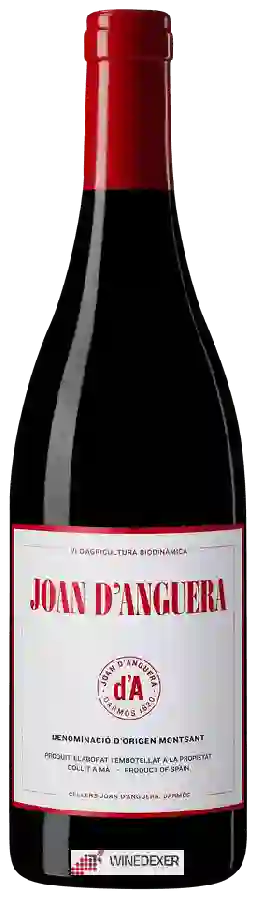
Winery Joan d'AngueraMontsant
 Red wine



In the mouth this red wine is a powerful with a nice balance between acidity and tannins.
This wine generally goes well with beef, lamb or pasta.

Taste structure of the Montsant from the Winery Joan d'Anguera
Light | Bold | |
Smooth | Tannic | |
Dry | Sweet | |
Soft | Acidic |
In the mouth the Montsant of Winery Joan d'Anguera in the region of Catalogne is a powerful with a nice balance between acidity and tannins.
Wine flavors and olphactive analysis



On the nose the Montsant of Winery Joan d'Anguera in the region of Catalogne often reveals types of flavors of non oak, earth or oak and sometimes also flavors of spices, red fruit or black fruit.
Food and wine pairings with Montsant
Pairings that work perfectly with Montsant



Original food and wine pairings with Montsant
The Montsant of Winery Joan d'Anguera matches generally quite well with dishes of beef, pasta or lamb such as recipes of sweet and sour turkish dumpling soup (eksili köfte), chinese noodles with vegetables and spices or lamb tagine with prunes and almonds.
Details and technical informations about Winery Joan d'Anguera's Montsant.
Discover the grape variety: Furmint
Taut, structured whites with cutting acidity and a mineral mouth, featuring aromas of apple, quince, citrus, honey, smoke and chalk notes. Made as ambitious dry wines (Tokaji száraz, Somló), off-dry and especially sumptuous botrytised sweet wines: Tokaji Aszú (legendary, classified by puttonyos) and Tokaji Eszencia. Highly susceptible to noble rot. The absolute star of Tokaj in Hungary, also in Slovakia, Slovenia (Šipon) and Austria. Native Hungarian grape.
Last vintages of this wine
The best vintages of Montsant from Winery Joan d'Anguera are 2016, 2015, 2013, 2012 and 0.
Informations about the Winery Joan d'Anguera
The Winery Joan d'Anguera is one of of the world's greatest estates. It offers 14 wines for sale in the of Montsant to come and discover on site or to buy online.

The wine region of Montsant
Catalan ring encircling the Priorat (Tarragona): signature Garnacha and Cariñena as king reds — concentrated and sunny with notes of ripe black fruits (blackberry, blackcurrant, plum), garrigue, Mediterranean herbs, liquorice and a mineral touch, fleshy tannins and a moreish finish, more accessible and fruity than Priorat. Syrah and Cabernet as backup. A few whites (Garnacha Blanca, Macabeu). DO (2001), schists ("llicorella") and clay-limestones, Mediterranean-continental climate.
The wine region of Catalogne
Cradle of Cava (~95% of Spanish output, traditional method): Macabeo, Xarel-lo, Parellada trilogy, fine fruity bubble. Quality peak in Priorat DOCa: dense, mineral reds on llicorella (schist), old-vine Garnacha and Cariñena with black fruit, garrigue notes, firm tannins. Also Penedès, fleshy Montsant, sunny Empordà, Costers del Segre. Mediterranean.
The word of the wine: Hairy
A sensual and complete wine that leaves a sensation of balance and fullness in the mouth.