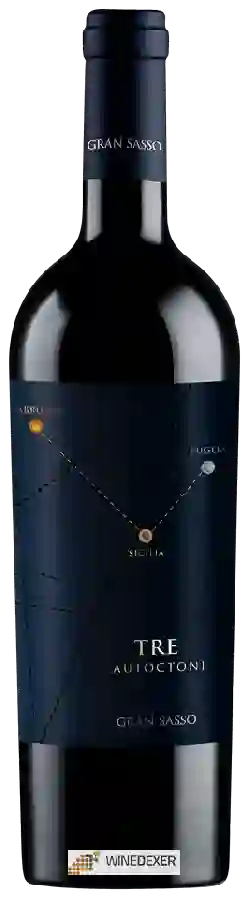
Winery Gran SassoTre Autoctoni
 Red wine


This wine is a blend of 2 varietals which are the Nerello mascalese and the Primitivo.
This wine generally goes well with pork, vegetarian or beef.
The Tre Autoctoni of the Winery Gran Sasso is in the top 10 of wines of Vino da Tavola.

Wine flavors and olphactive analysis


On the nose the Tre Autoctoni of Winery Gran Sasso in the region of Vino da Tavola often reveals types of flavors of oak.
Food and wine pairings with Tre Autoctoni
Pairings that work perfectly with Tre Autoctoni



Original food and wine pairings with Tre Autoctoni



The Tre Autoctoni of Winery Gran Sasso matches generally quite well with dishes of beef, lamb or veal such as recipes of alsatian bäckeoffe, traditional tunisian couscous or veal tagine with potatoes and olives.
Details and technical informations about Winery Gran Sasso's Tre Autoctoni.
Discover the grape variety: Nerello mascalese
Elegant, taut reds with a pale ruby colour (often compared to Pinot Noir and Nebbiolo), fine tannins and high acidity, on aromas of red cherry, raspberry, Mediterranean herbs, dried flowers, spices, graphite and volcanic mineral notes. Fine ageing potential. The absolute star of Etna Rosso DOC, thriving on the black lava flows of the north and east contrade. Also in Faro DOC. Native Sicilian high-altitude grape.
Last vintages of this wine
The best vintages of Tre Autoctoni from Winery Gran Sasso are 2013, 0, 2011, 2012
Informations about the Winery Gran Sasso
The Winery Gran Sasso is one of of the world's greatest estates. It offers 29 wines for sale in the of Vino da Tavola to come and discover on site or to buy online.

The wine region of Vino da Tavola
The freest category of Italian wine, with no grape or zone constraint. All styles: bold reds based on Bordeaux grapes (Cabernet, Merlot), atypical blends, maker's cuvées outside DOC rules. Historic cradle of the "Super Tuscans" in the 1960s-80s (Sassicaia, Tignanello, Ornellaia) before the creation of IGT in 1992. Today dedicated to everyday wines or winemaker experiments.
The word of the wine: Rootstock
American vine on which a French vine is grafted. This is the consequence of the phylloxera that destroyed the vineyard at the end of the 19th century: after much trial and error, it was discovered that the "pest" spared the roots of the American vines, and the technique became widespread.





