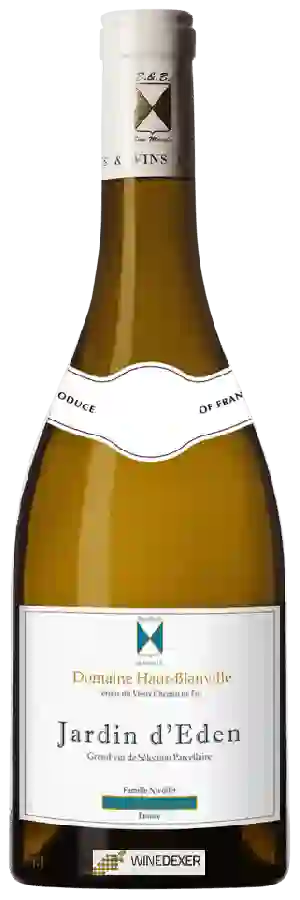
Château Haut BlanvilleJardin d'Eden
 White wine
In the mouth this white wine is a powerful.
This wine generally goes well with vegetarian, poultry or lean fish.

Taste structure of the Jardin d'Eden from the Château Haut Blanville
Light | Bold | |
Dry | Sweet | |
Soft | Acidic |
In the mouth the Jardin d'Eden of Château Haut Blanville in the region of Languedoc-Roussillon is a powerful.


Food and wine pairings with Jardin d'Eden
Pairings that work perfectly with Jardin d'Eden



Original food and wine pairings with Jardin d'Eden


The Jardin d'Eden of Château Haut Blanville matches generally quite well with dishes of pasta, vegetarian or poultry such as recipes of express beef cannelloni, broccoli and blue cheese quiche without pastry or milanese escalope (italy).
Details and technical informations about Château Haut Blanville's Jardin d'Eden.
Discover the grape variety: Roussanne
Aromatic and elegant whites, rich yet lifted by fine freshness, with hawthorn, honeysuckle, apricot, pear, honey, green tea, mineral and herbal notes. Fine ageing potential. Key variety in the great whites of the northern Rhône (Hermitage, Crozes-Hermitage, Saint-Joseph, Saint-Péray) blended with marsanne, and one of the 13 permitted grapes at Châteauneuf-du-Pape. Native Rhône variety.
Informations about the Château Haut Blanville
The Château Haut Blanville is one of of the world's great estates. It offers 80 wines for sale in the of Languedoc-Roussillon to come and discover on site or to buy online.

The wine region of Languedoc-Roussillon
Largest single French vineyard, dominated by sunny, generous reds. Spicy Syrah, candied Grenache (ripe fruit, garrigue), structured Carignan, deep Mourvèdre, supple Cinsault. Stars: structured Corbières, Minervois, Faugères, Saint-Chinian; round Côtes-du-Roussillon. Legendary vins doux naturels: Banyuls and Maury (fortified Grenache) with notes of cocoa, fig, prune.
The word of the wine: Marcottage
A vine reproduction technique that consists of burying a vine shoot that takes root and reproduces a plant with the same characteristics as the vine to which it is attached (synonym: provignage).