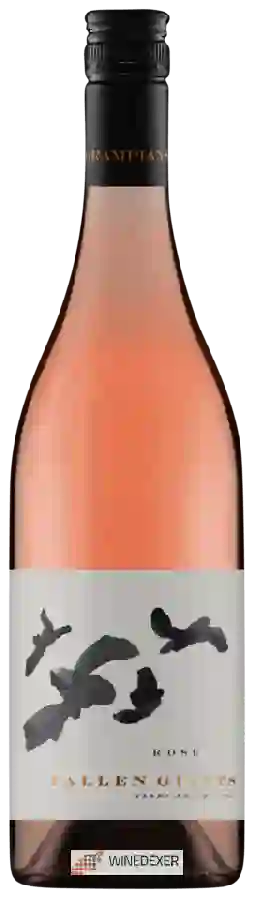
Winery Halls GapFallen Giants Rosé
 Pink wine



This wine generally goes well with beef, lamb or mature and hard cheese.
Food and wine pairings with Fallen Giants Rosé
Pairings that work perfectly with Fallen Giants Rosé



Original food and wine pairings with Fallen Giants Rosé

The Fallen Giants Rosé of Winery Halls Gap matches generally quite well with dishes of beef, lamb or spicy food such as recipes of traditional flemish carbonades, lamb in a crown with spring vegetables or thai beef wok.
Details and technical informations about Winery Halls Gap's Fallen Giants Rosé.
Discover the grape variety: Optima
Intraspecific crossing between sylvaner x riesling (perhaps rieslaner) and müller-thurgau obtained in 1930 by Peter Morio (1887-1960) and Bernhard Husfeld (1900-1970) at the Siebeldingen Research Institute (Palatinate) in Germany. It can be found in Germany, Switzerland, Belgium, Austria, the Netherlands, Hungary, England, Canada, South Africa, Brazil, ... very little known in France. Note that Optima is the mother of the Orion grape variety.
Last vintages of this wine
The best vintages of Fallen Giants Rosé from Winery Halls Gap are 0
Informations about the Winery Halls Gap
The Winery Halls Gap is one of of the world's greatest estates. It offers 9 wines for sale in the of Victoria to come and discover on site or to buy online.

The wine region of Victoria
Victoria is a relatively small but important Australian wine state. Located in the Southeastern corner of the continent, with a generally cool, ocean-influenced Climate, Victorian wine is remarkably diverse, producing all sorts of wines and styles in different climates. In all, the state covers almost 250,000 square kilometres (over 90,000 square miles) of land (almost the same Size as the US state of Texas), well under a quarter the size of its western neighbour, South Australia, and less than a third the size of New South Wales to the North. As such, Victoria's size - and to some extent, the state's viticultural history - can defy generalization.
The word of the wine: Alcohol
A generic term for the various alcohols produced during fermentation that give the wine body, structure and warmth.