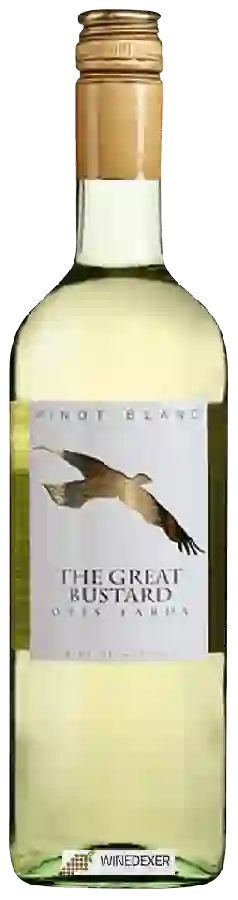
Winery The Great BustardPinot Blanc
 White wine


This wine generally goes well with rich fish (salmon, tuna etc) and shellfish.
Food and wine pairings with Pinot Blanc
Pairings that work perfectly with Pinot Blanc


Original food and wine pairings with Pinot Blanc
The Pinot Blanc of Winery The Great Bustard matches generally quite well with dishes of rich fish (salmon, tuna etc) or shellfish such as recipes of light salmon steaks and or armorican-style squid.
Details and technical informations about Winery The Great Bustard's Pinot Blanc.
Discover the grape variety: Pinot blanc
Pinot Blanc is a grape variety that originated in Burgundy, mutated from Pinot Gris. Today, it is grown in Alsace where it is called klevner when blended with auxerrois. The continental climate, with its cold winters and hot summers, is particularly suited to pinot blanc. It is resistant to frost in winter and in summer, the roots draw the minerals it needs from the warm soil. Its bunches are made up of small berries with thick skins and melting pulp that produce fruity, spicy wines, balanced between acidity and alcohol. pinot blanc is also used for crémants and sparkling wines. Pinot Blanc is also used for Crémant and sparkling wines. It is widely grown in Italy, where it covers almost 7,000 hectares, and is also found in Germany, Austria, Canada and South Africa.
Last vintages of this wine

The best vintages of Pinot Blanc from Winery The Great Bustard are 2012, 2017, 2018, 2013 and 0.
Informations about the Winery The Great Bustard
The Winery The Great Bustard is one of of the world's greatest estates. It offers 3 wines for sale in the of Hungary to come and discover on site or to buy online.

The wine region of Hungary
Hungary, in Central Europe, has gained its reputation in the wine world through just a couple of wine styles, but for centuries it has been a wine-producing nation of considerable diversity. In addition to the Sweet wines of Tokaj and the Deep Bull's Blood of Eger, the Hungarian wine portfolio includes Dry whites from the shores of Lake Balaton, Somló and Neszmély, and finer reds from various regions, notably Villány, Sopron and Szekszard. Hungarian wine culture stretches back to Roman times and has survived numerous political, religious and economic challenges, including Islamic rule during the 16th Century (when Alcohol was prohibited) and the Phylloxera epidemic of the late 1800s. The modern Hungarian wine regions are distributed around the country.
The word of the wine: Provignage
A vine reproduction technique that consists of burying a vine shoot that takes root and reproduces a plant with the same characteristics as the vine to which it is attached.