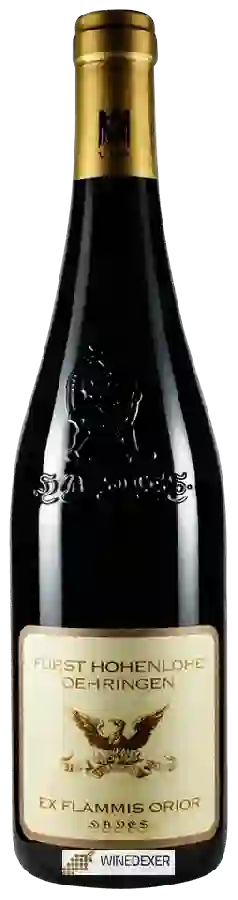
Winery Fürst Hohenlohe OehringenHADES Ex Flammis Orior
 Red wine


In the mouth this red wine is a with a nice freshness.
This wine generally goes well with poultry, beef or veal.
The HADES Ex Flammis Orior of the Winery Fürst Hohenlohe Oehringen is in the top 60 of wines of Württemberg.

Taste structure of the HADES Ex Flammis Orior from the Winery Fürst Hohenlohe Oehringen
Light | Bold | |
Smooth | Tannic | |
Dry | Sweet | |
Soft | Acidic |
In the mouth the HADES Ex Flammis Orior of Winery Fürst Hohenlohe Oehringen in the region of Württemberg is a with a nice freshness.
Food and wine pairings with HADES Ex Flammis Orior
Pairings that work perfectly with HADES Ex Flammis Orior



Original food and wine pairings with HADES Ex Flammis Orior

The HADES Ex Flammis Orior of Winery Fürst Hohenlohe Oehringen matches generally quite well with dishes of beef, veal or game (deer, venison) such as recipes of beef tenderloin wellington, sauté of veal with chorizo or stuffed duck or goose neck.
Details and technical informations about Winery Fürst Hohenlohe Oehringen's HADES Ex Flammis Orior.
Discover the grape variety: Pineau d'Aunis
Light, spicy reds with a clear ruby robe, fine tannins and fresh acidity, with characteristic aromas of black pepper, red fruit (raspberry, redcurrant), spice and herbal notes. Airy, refreshing palate with a signature peppery finish. Also made as very expressive, taut rosés. Star of Coteaux du Vendômois AOC, present in Anjou, Touraine and Coteaux du Loir AOC. Autochthonous Loire Valley variety, present since the 12th century (favourite wine of Henry Plantagenet).
Last vintages of this wine

The best vintages of HADES Ex Flammis Orior from Winery Fürst Hohenlohe Oehringen are 2014, 2012, 2011, 2013 and 0.
Informations about the Winery Fürst Hohenlohe Oehringen
The Winery Fürst Hohenlohe Oehringen is one of of the world's greatest estates. It offers 72 wines for sale in the of Württemberg to come and discover on site or to buy online.

The wine region of Württemberg
Rare predominantly red region in Germany (nearly 70%). Supple, fruity everyday reds: light, crisp Trollinger (Schiava) with red fruits, more structured, spicy, deep Lemberger (Blaufränkisch), generous Schwarzriesling (Pinot Meunier). Riesling king of whites (>2,000 ha), lively and mineral, citrus and green apple. Germany's 4th region (11,500 ha) on the Neckar slopes around Heilbronn and Stuttgart.
The word of the wine: Basic wine
Dry, still wine intended for the production of sparkling wines (champagne, crémants, etc.). The basic wines undergo a second fermentation in the bottle for the production of carbon dioxide, and therefore of bubbles.