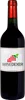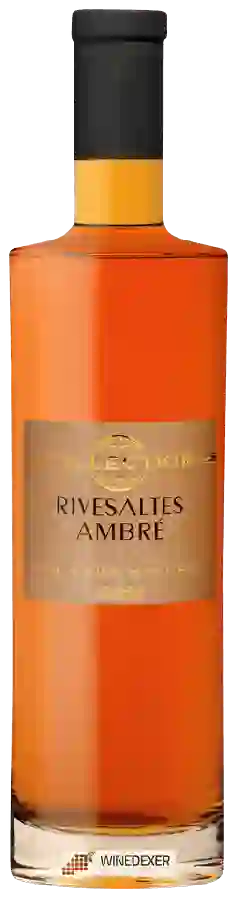
Vignerons CatalansCollection Rivesaltes Ambré
 Sweet wine



This wine generally goes well with poultry, rich fish (salmon, tuna etc) or shellfish.
Wine flavors and olphactive analysis



On the nose the Collection Rivesaltes Ambré of Vignerons Catalans in the region of Languedoc-Roussillon often reveals types of flavors of oaky, apples or apricot and sometimes also flavors of caramel, raisin or honey.
Food and wine pairings with Collection Rivesaltes Ambré
Pairings that work perfectly with Collection Rivesaltes Ambré



Original food and wine pairings with Collection Rivesaltes Ambré
The Collection Rivesaltes Ambré of Vignerons Catalans matches generally quite well with dishes of rich fish (salmon, tuna etc), shellfish or poultry such as recipes of fish balls, penne with shrimp and zucchini or potato and bacon omelette.
Details and technical informations about Vignerons Catalans's Collection Rivesaltes Ambré.
Discover the grape variety: Cabernet blanc
Interspecific cross between Cabernet Sauvignon and a long-unknown grape variety - that would be Regent - obtained in 1991 by Valentin Blattner from Soyhières (Switzerland) and propagated by Volker Freytag (Germany). No resistance gene has been identified to either mildew or powdery mildew. Cabernet blanc can be found in Switzerland, Belgium, the Netherlands, Germany, Austria, Luxembourg, the Czech Republic, Italy, England, etc., but is still little known in France.
Last vintages of this wine
The best vintages of Collection Rivesaltes Ambré from Vignerons Catalans are 2009, 2005
Informations about the Vignerons Catalans
The Vignerons Catalans is one of of the world's great estates. It offers 200 wines for sale in the of Rivesaltes to come and discover on site or to buy online.

The wine region of Rivesaltes
Rivesaltes is an appellation for the historic Sweet wines of eastern Roussillon, in the DeepSouth of France. The natural sweet wines produced in this region have been revered since at least the 14th century. The technique used to make them is one of many techniques used for sweet wines. Unlike botrytized wines or ice wines, natural sweet wines are made by Mutage, a process that involves stopping the Fermentation of the must while a high level of natural sweetness remains.
The wine region of Languedoc-Roussillon
Languedoc (formerly Coteaux du Languedoc) is a key appellation used in the Languedoc-Roussillon wine region of southern France. It covers Dry table wines of all three colors (red, white and rosé) from the entire region, but leaves Sweet and Sparkling wines to other more specialized appellations. About 75% of all Languedoc wines are red, with the remaining 25% split roughly down the middle between whites and rosés. The appellation covers most of the Languedoc region and almost a third of all the vineyards in France.
The word of the wine: Wirehood
Flexible metal fastener used to hold the cork of champagne bottles.