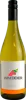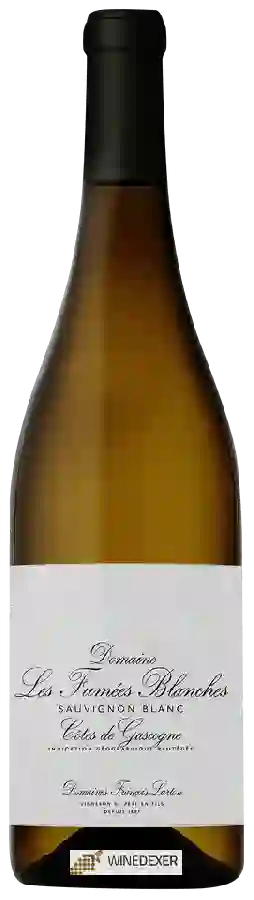
Winery François LurtonLes Fumées Blanches Sauvignon Blanc Côtes de Gascogne
 White wine



In the mouth this white wine is a .
This wine generally goes well with vegetarian, poultry or lean fish.
Taste structure of the Les Fumées Blanches Sauvignon Blanc Côtes de Gascogne from the Winery François Lurton
Light | Bold | |
Dry | Sweet | |
Soft | Acidic |
In the mouth the Les Fumées Blanches Sauvignon Blanc Côtes de Gascogne of Winery François Lurton in the region of Comté Tolosan is a .
Wine flavors and olphactive analysis


On the nose the Les Fumées Blanches Sauvignon Blanc Côtes de Gascogne of Winery François Lurton in the region of Comté Tolosan often reveals types of flavors of grapefruit, citrus or peach and sometimes also flavors of minerality, melon or earth.
Food and wine pairings with Les Fumées Blanches Sauvignon Blanc Côtes de Gascogne
Pairings that work perfectly with Les Fumées Blanches Sauvignon Blanc Côtes de Gascogne



Original food and wine pairings with Les Fumées Blanches Sauvignon Blanc Côtes de Gascogne


The Les Fumées Blanches Sauvignon Blanc Côtes de Gascogne of Winery François Lurton matches generally quite well with dishes of pasta, vegetarian or poultry such as recipes of pasta shells, cream and tuna quiche or keftas tajine with eggs.
Details and technical informations about Winery François Lurton's Les Fumées Blanches Sauvignon Blanc Côtes de Gascogne.
Discover the grape variety: Cabernet franc
Cabernet Franc is one of the oldest red grape varieties in Bordeaux. The Libourne region is its terroir where it develops best. The terroirs of Saint-Emilion and Fronsac allow it to mature and develop its best range of aromas. It is also the majority in many blends. The very famous Château Cheval Blanc, for example, uses 60% Cabernet Franc. The wines produced with Cabernet Franc are medium in colour with fine tannins and subtle aromas of small red fruits and spices. When blended with Merlot and Cabernet Sauvignon, it brings complexity and a bouquet of aromas to the wine. It produces fruity wines that can be drunk quite quickly, but whose great vintages can be kept for a long time. It is an earlier grape variety than Cabernet Sauvignon, which means that it is planted as far north as the Loire Valley. In Anjou, it is also used to make sweet rosé wines. Cabernet Franc is now used in some twenty countries in Europe and throughout the world.
Last vintages of this wine
The best vintages of Les Fumées Blanches Sauvignon Blanc Côtes de Gascogne from Winery François Lurton are 2017, 2018, 2019
Informations about the Winery François Lurton
The Winery François Lurton is one of of the world's great estates. It offers 109 wines for sale in the of Côtes de Gascogne to come and discover on site or to buy online.

The wine region of Côtes de Gascogne
The wine region of Côtes de Gascogne is located in the region of Comté Tolosan of Vin de Pays of France. Wineries and vineyards like the Domaine Sichel or the Domaine Haut-Marin produce mainly wines white, red and sweet. The most planted grape varieties in the region of Côtes de Gascogne are Colombard, Gros Manseng and Merlot, they are then used in wines in blends or as a single variety. On the nose of Côtes de Gascogne often reveals types of flavors of red fruit, tangerine or jam and sometimes also flavors of watermelon, pomegranate or lemon grass.
The wine region of Comté Tolosan
Comte Tolosan is a PGI title that covers wines produced in a large area of Southwestern France. The PGI basin encompasses 12 administrative dePartments and is home to a wide range of appellations d'origine contrôlée (AOC) such as Jurançon, Cahors and Armagnac. The IGP label provides a geographical classification for wines that are not classified for AOC level appellations due to Grape variety or winemaking style. The region is part of the Aquitaine basin - the plains that lie between the Pyrenees, the Massif Central and the Atlantic Ocean to the west.
The word of the wine: Tries (harvest by)
Harvesting in several successive passages to harvest at their optimal concentration the grapes affected by noble rot. They allow the production of great sweet wines.