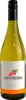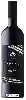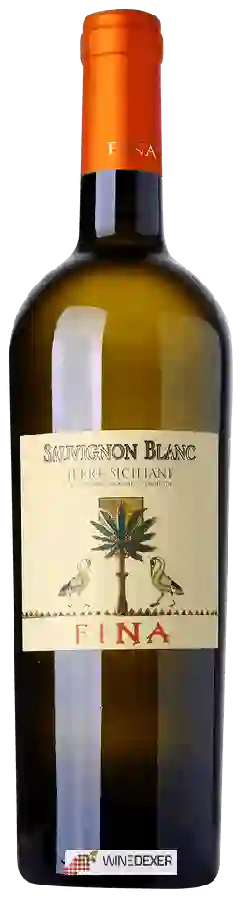
Winery FinaSauvignon Blanc
 White wine



In the mouth this white wine is a powerful.
This wine generally goes well with vegetarian, appetizers and snacks or shellfish.

Taste structure of the Sauvignon Blanc from the Winery Fina
Light | Bold | |
Dry | Sweet | |
Soft | Acidic |
In the mouth the Sauvignon Blanc of Winery Fina in the region of Sicily is a powerful.
Food and wine pairings with Sauvignon Blanc
Pairings that work perfectly with Sauvignon Blanc



Original food and wine pairings with Sauvignon Blanc
The Sauvignon Blanc of Winery Fina matches generally quite well with dishes of shellfish, vegetarian or appetizers and snacks such as recipes of fish fondue, spinach and goat cheese quiche or kale chips.
Details and technical informations about Winery Fina's Sauvignon Blanc.
Discover the grape variety: Epinou
Simple, light and fruity reds with a pale ruby colour, melted tannins and a light palate with moderate acidity, showing undemonstrative aromas of red fruits. A discreet rustic profile. Almost disappeared from commercial cultivation, preserved in INRAE varietal collections, it bears witness to pre-phylloxera ampelographic diversity and is among the heritage varieties under study. Rare French black variety, once grown in the South-West.
Last vintages of this wine
The best vintages of Sauvignon Blanc from Winery Fina are 2013, 2012, 2008, 0 and 2014.
Informations about the Winery Fina
The Winery Fina is one of of the world's great estates. It offers 30 wines for sale in the of Sicily to come and discover on site or to buy online.

The wine region of Sicily
Major qualitative renewal. Sunny, expressive reds: fleshy, spicy Nero d'Avola (black cherry, blackberry, liquorice), fine, mineral Nerello Mascalese on Etna (recalls Pinot Noir), light, crisp Frappato in Cerasuolo di Vittoria DOCG. Lively, saline whites: Catarratto, fat, iodised Grillo, taut Carricante, floral Inzolia. Amber, walnutty fortified Marsala.
The word of the wine: Oxidative (breeding)
A method of ageing which aims to give the wine certain aromas of evolution (dried fruit, bitter orange, coffee, rancio, etc.) by exposing it to the air; it is then matured either in barrels, demi-muids or unoaked casks, sometimes stored in the open air, or in barrels exposed to the sun and to temperature variations. This type of maturation characterizes certain natural sweet wines, ports and other liqueur wines.