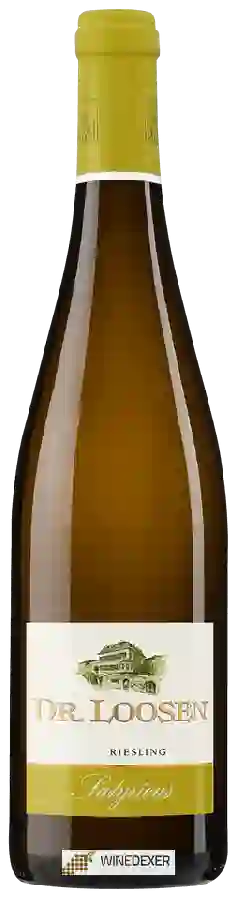
Winery Dr. LoosenRiesling Satyricus
 White wine



In the mouth this white wine is a with a nice freshness.
This wine generally goes well with pork, poultry or shellfish.

Taste structure of the Riesling Satyricus from the Winery Dr. Loosen
Light | Bold | |
Dry | Sweet | |
Soft | Acidic |
In the mouth the Riesling Satyricus of Winery Dr. Loosen in the region of Mosel is a with a nice freshness.
Wine flavors and olphactive analysis

On the nose the Riesling Satyricus of Winery Dr. Loosen in the region of Mosel often reveals types of flavors of earth, tree fruit or citrus fruit.
Food and wine pairings with Riesling Satyricus
Pairings that work perfectly with Riesling Satyricus



Original food and wine pairings with Riesling Satyricus


The Riesling Satyricus of Winery Dr. Loosen matches generally quite well with dishes of pork, shellfish or spicy food such as recipes of blue cord, cuttlefish in sauce or cicadas at the chib.
Details and technical informations about Winery Dr. Loosen's Riesling Satyricus.
Discover the grape variety: Riesling
Crystalline, taut whites with vibrant acidity and aromas of citrus, green apple, white flowers, vineyard peach and mineral/petrol notes with age. Made as dry (Trocken, Alsace), off-dry (Kabinett, Spätlese) and sweet (Auslese, Beerenauslese, Trockenbeerenauslese, late harvest). Star of the Moselle, Rheingau, Alsace AOC and Wachau. Also exported to Clare Valley and Finger Lakes.
Last vintages of this wine
The best vintages of Riesling Satyricus from Winery Dr. Loosen are 2015, 2012, 2014, 0 and 2018.
Informations about the Winery Dr. Loosen
The Winery Dr. Loosen is one of of the world's great estates. It offers 151 wines for sale in the of Mosel to come and discover on site or to buy online.

The wine region of Mosel
Kingdom of lively, crystalline Riesling: citrus, green apple, gunflint, tangy tension and signature slate minerality. From light, fruity Kabinett to off-dry Spätlese, up to sweet Auslese and Trockenbeerenauslese of rare finesse. Some supple Müller-Thurgau and lively Elbling. Steeply sloped vineyards (up to 65% at the Bremmer Calmont) on blue and grey slate, 5,400 ha of Riesling (61.
The word of the wine: Passerillage
Concentration of the grape by drying out, under the influence of wind or sun, as opposed to botrytisation, which is the concentration obtained by the development of the "noble rot" for which Botrytis cinerea is responsible. The word is mainly used for sweet wines.