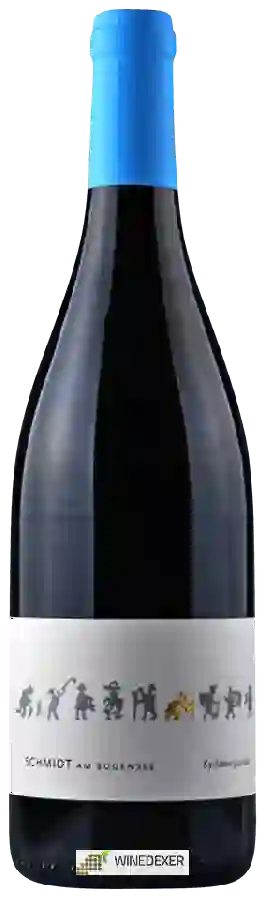
Winery Schmidt Am BodenseeSpätburgunder
 Red wine


In the mouth this red wine is a with a nice freshness.
This wine generally goes well with poultry, beef or veal.
Taste structure of the Spätburgunder from the Winery Schmidt Am Bodensee
Light | Bold | |
Smooth | Tannic | |
Dry | Sweet | |
Soft | Acidic |
In the mouth the Spätburgunder of Winery Schmidt Am Bodensee in the region of Württemberg is a with a nice freshness.
Wine flavors and olphactive analysis

On the nose the Spätburgunder of Winery Schmidt Am Bodensee in the region of Württemberg often reveals types of flavors of red fruit.
Food and wine pairings with Spätburgunder
Pairings that work perfectly with Spätburgunder



Original food and wine pairings with Spätburgunder

The Spätburgunder of Winery Schmidt Am Bodensee matches generally quite well with dishes of beef, veal or game (deer, venison) such as recipes of beef coarse salt, potjevleesch (meat in a pot) or duck aiguillettes.
Details and technical informations about Winery Schmidt Am Bodensee's Spätburgunder.
Discover the grape variety: Blancard
Originally from the southwestern Atlantic region of France, Blancard has long been cultivated in the Gers, Landes, Eastern Pyrenees and the High Pyrenees. Blancard is practically no longer present in the vineyards and is therefore in danger of disappearing.
Last vintages of this wine
The best vintages of Spätburgunder from Winery Schmidt Am Bodensee are 2017, 0
Informations about the Winery Schmidt Am Bodensee
The Winery Schmidt Am Bodensee is one of of the world's greatest estates. It offers 19 wines for sale in the of Württemberg to come and discover on site or to buy online.

The wine region of Württemberg
Württemberg is known as Germany's premier red wine region. With almost 11,500 hectares (28,500 acres) of vineyards, it is the fourth-largest wine region in the country. Found adjacent to Baden and South of Franken, Wüttemberg is a particularly hilly and rural wine-region. Almost 70-percent of Württemberg wines are red, predominantly made from Trollinger, SchwarzRiesling and Lemberger.
The word of the wine: Malolactic fermentation
Called second fermentation or malo for short. It is the degradation (under the effect of bacteria) of the malic acid naturally present in the wine into milder, less aggressive lactic acid. Some producers or wineries refuse this operation by "blocking the malo" (by cold and adding SO2) to keep a maximum of acidity which carries the aromas and accentuates the sensation of freshness.