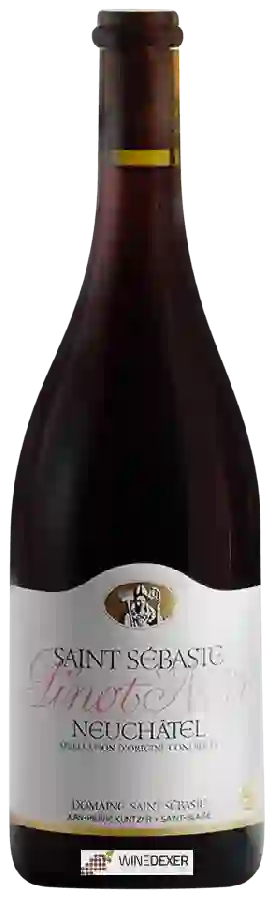
Domaine Saint-SébastePinot Noir
 Red wine



In the mouth this red wine is a with a nice freshness.
This wine generally goes well with poultry, beef or veal.
The Pinot Noir of the Domaine Saint-Sébaste is in the top 60 of wines of Neuchâtel.

Taste structure of the Pinot Noir from the Domaine Saint-Sébaste
Light | Bold | |
Smooth | Tannic | |
Dry | Sweet | |
Soft | Acidic |
In the mouth the Pinot Noir of Domaine Saint-Sébaste in the region of Neuchâtel is a with a nice freshness.
Wine flavors and olphactive analysis



On the nose the Pinot Noir of Domaine Saint-Sébaste in the region of Neuchâtel often reveals types of flavors of earth, red fruit.
Food and wine pairings with Pinot Noir
Pairings that work perfectly with Pinot Noir



Original food and wine pairings with Pinot Noir

The Pinot Noir of Domaine Saint-Sébaste matches generally quite well with dishes of beef, veal or game (deer, venison) such as recipes of braciola (southern italy), blanquette of veal in pickle sauce or duck breast with balsamic vinegar.
Details and technical informations about Domaine Saint-Sébaste's Pinot Noir.
Discover the grape variety: Pinot noir
Elegant reds, light in colour with silky tannins, showing strawberry, cherry and raspberry aromas, evolving to forest floor, mushroom and spice with age. Fresh acidity, delicate finish. Star of the Côte d'Or (Romanée-Conti, Chambertin, Volnay), pillar of Champagne (Blanc de Noirs) and signature of Oregon, Central Otago and Sonoma Coast. An early-ripening Burgundian variety, one of the world's greatest.
Last vintages of this wine
The best vintages of Pinot Noir from Domaine Saint-Sébaste are 2012, 2015, 2011, 2018 and 2017.
Informations about the Domaine Saint-Sébaste
The Domaine Saint-Sébaste is one of of the world's greatest estates. It offers 26 wines for sale in the of Neuchâtel to come and discover on site or to buy online.

The wine region of Neuchâtel
Swiss vineyard on the western shore of the lake, 606 ha in the Three Lakes region. Signature Pinot Noir (55% of the vineyard, the local prince): fine, fresh reds with notes of cherry, raspberry, undergrowth and sweet spices, silky tannins. Specialty invented here: Œil-de-Perdrix, a delicate Pinot Noir rosé with salmon hues. Lively, mineral Chasselas (citrus, flint) in white, including the identity-marking Non-Filtré primeur.
The word of the wine: Yeast
Micro-organisms at the base of all fermentative processes. A wide variety of yeasts live and thrive naturally in the vineyard, provided that treatments do not destroy them. Unfortunately, their replacement by laboratory-selected yeasts is often the order of the day and contributes to the standardization of the wine. Yeasts are indeed involved in the development of certain aromas.