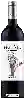
Domaine Nadal HainautLa Couloumine
 Red wine



In the mouth this red wine is a powerful with a nice balance between acidity and tannins.
This wine generally goes well with beef, veal or pasta.
Taste structure of the La Couloumine from the Domaine Nadal Hainaut
Light | Bold | |
Smooth | Tannic | |
Dry | Sweet | |
Soft | Acidic |
In the mouth the La Couloumine of Domaine Nadal Hainaut in the region of Languedoc-Roussillon is a powerful with a nice balance between acidity and tannins.
Food and wine pairings with La Couloumine
Pairings that work perfectly with La Couloumine



Original food and wine pairings with La Couloumine
The La Couloumine of Domaine Nadal Hainaut matches generally quite well with dishes of beef, pasta or veal such as recipes of traditional flemish carbonades, cannelloni with parma ham or tête de veau sauce moi.
Details and technical informations about Domaine Nadal Hainaut's La Couloumine.
Discover the grape variety: Pirobella
Interspecific crossing, obtained in South Africa in the 1960s by E.P. Evans, between the 15 Pirovano (madeleine angevine X bellino) and the isabelle. It should be noted that from this cross was also born the black muska.
Last vintages of this wine
The best vintages of La Couloumine from Domaine Nadal Hainaut are 2017
Informations about the Domaine Nadal Hainaut
The Domaine Nadal Hainaut is one of of the world's greatest estates. It offers 35 wines for sale in the of Côtes du Roussillon to come and discover on site or to buy online.

The wine region of Côtes du Roussillon
Côtes du Roussillon is an appellation contrôlée for red, white and rosé wines from the Roussillon wine region in southern France. It covers the eastern half of the administrative district of the Pyrénées-Orientales, on the eastern edge of the Pyrenees. The western half of the Pyrenees-Orientales is simply too mountainous for effective viticulture. In the Côtes du Roussillon wine-growing area is the Aspres sub-region.
The wine region of Languedoc-Roussillon
Languedoc (formerly Coteaux du Languedoc) is a key appellation used in the Languedoc-Roussillon wine region of southern France. It covers Dry table wines of all three colors (red, white and rosé) from the entire region, but leaves Sweet and Sparkling wines to other more specialized appellations. About 75% of all Languedoc wines are red, with the remaining 25% split roughly down the middle between whites and rosés. The appellation covers most of the Languedoc region and almost a third of all the vineyards in France.
The word of the wine: Champagne rosé
Often obtained by adding red wines (from Champagne), it is even the only vineyard where this practice is allowed. Some producers prefer the practice used in other regions, i.e. a short maceration to extract sufficient colouring matter. This results in winey rosés for meals. Elegant aperitif rosé is more often made from red wine coloured Chardonnay. Rosés can be vintage or non vintage.