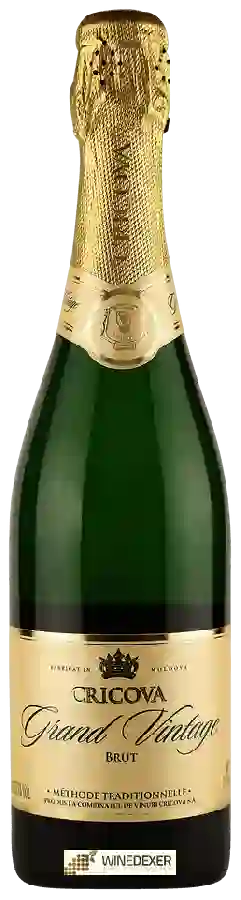
Winery CricovaGrand Vintage Brut
 Sparkling wine


This wine generally goes well with pork, poultry or veal.
The Grand Vintage Brut of the Winery Cricova is in the top 10 of wines of Moldavie.

Wine flavors and olphactive analysis



On the nose the Grand Vintage Brut of Winery Cricova in the region of Moldavie often reveals types of flavors of non oak, earth or microbio and sometimes also flavors of oak, tree fruit or citrus fruit.
Food and wine pairings with Grand Vintage Brut
Pairings that work perfectly with Grand Vintage Brut



Original food and wine pairings with Grand Vintage Brut


The Grand Vintage Brut of Winery Cricova matches generally quite well with dishes of veal, pork or game (deer, venison) such as recipes of cordon bleu with veal and cured ham, tartiflette (from a real savoyard) or duck parmentier with ceps.
Details and technical informations about Winery Cricova's Grand Vintage Brut.
Discover the grape variety: Pinot noir
Elegant reds, light in colour with silky tannins, showing strawberry, cherry and raspberry aromas, evolving to forest floor, mushroom and spice with age. Fresh acidity, delicate finish. Star of the Côte d'Or (Romanée-Conti, Chambertin, Volnay), pillar of Champagne (Blanc de Noirs) and signature of Oregon, Central Otago and Sonoma Coast. An early-ripening Burgundian variety, one of the world's greatest.
Last vintages of this wine

The best vintages of Grand Vintage Brut from Winery Cricova are 2007, 2009, 0, 2012
Informations about the Winery Cricova
The Winery Cricova is one of of the world's great estates. It offers 105 wines for sale in the of Moldavie to come and discover on site or to buy online.

The wine region of Moldavie
Ancestral vineyard with identity grapes. Fetească Neagră, great Moldovan red reference: deep with notes of ripe plum, black cherry, spice and tobacco, melted tannins. Lighter, more floral Rară Neagră (Băbească). Dense tinctorial Saperavi.
The word of the wine: Terroir
Strictly speaking, the notion of terroir corresponds to the geological characteristics of a vineyard. However, when we talk about terroir, we take into account the soil, the climate (even the microclimate), the flora, the fauna, and the human factor that characterizes the practices that make up the art of the craft.