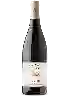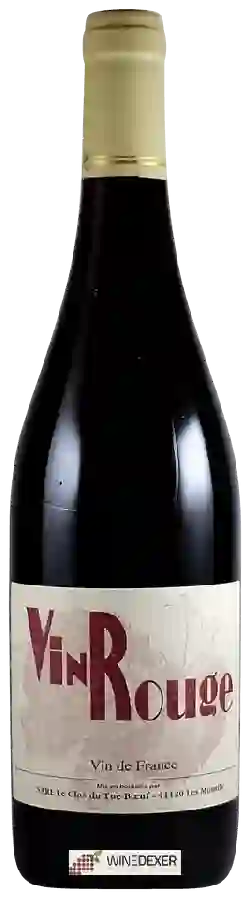
Clos du Tue-BoeufVin Rouge
 Red wine


This wine is composed of 100% of the grape variety Gamay.
This wine generally goes well with beef

Wine flavors and olphactive analysis




On the nose the Vin Rouge of Clos du Tue-Boeuf in the region of Pays d'Oc often reveals types of flavors of cherry, smoke or earthy and sometimes also flavors of blackberry, minerality or red fruit.
Food and wine pairings with Vin Rouge
Pairings that work perfectly with Vin Rouge

Original food and wine pairings with Vin Rouge
The Vin Rouge of Clos du Tue-Boeuf matches generally quite well with dishes of beef such as recipes of mexican beef tacos.
Details and technical informations about Clos du Tue-Boeuf's Vin Rouge.
Discover the grape variety: Gamay noir
Light, juicy reds, low in tannins with crunchy freshness, showing aromas of wild strawberry, raspberry, banana (from carbonic maceration) and peony. Easy-drinking style of Beaujolais Nouveau, more structured and mineral on the granites of the ten crus (Morgon, Moulin-à-Vent, Fleurie, Brouilly). Also in Touraine, Auvergne and Swiss Romande. A Burgundian variety, a cross of Pinot Noir × Gouais Blanc.
Last vintages of this wine

The best vintages of Vin Rouge from Clos du Tue-Boeuf are 2018, 2017, 2019, 2012 and 2016.
Informations about the Clos du Tue-Boeuf
The Clos du Tue-Boeuf is one of of the world's greatest estates. It offers 31 wines for sale in the of Vin de Pays to come and discover on site or to buy online.

The wine region of Vin de Pays
Intermediate category between AOC and Vin de France (renamed IGP in 2009), 27% of national volume. Accessible, expressive wines defined by their grape: opulent Chardonnay, lively Sauvignon, round Merlot, peppery Syrah, floral Viognier with apricot. 76 IGP in France at 3 scales: regional (Pays d'Oc, Méditerranée, Val de Loire), departmental or local. Flexible rules, wide range of permitted grapes, free grape and vintage labelling.
The wine region of Pays d'Oc
The single-grape IGP par excellence: modern, accessible, frank and fruity wines, the popular signature of the Midi. Spicy Syrah reds (pepper, blackberry), round Merlot, structured Cabernet, generous Grenache, supple Cinsault. Crisp, tangy rosés. Opulent Chardonnay whites, lively Sauvignon, floral, apricoty Viognier.
The word of the wine: Brut nature (or ultra brut)
A type of champagne that has not received any dosage liqueur.