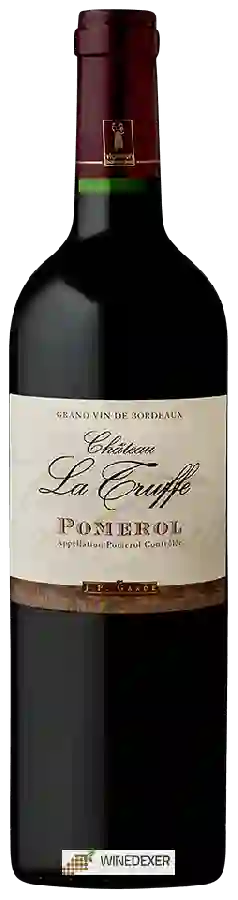
Château La TruffePomerol
 Red wine



In the mouth this red wine is a powerful with a nice balance between acidity and tannins.
This wine generally goes well with poultry, beef or game (deer, venison).

Taste structure of the Pomerol from the Château La Truffe
Light | Bold | |
Smooth | Tannic | |
Dry | Sweet | |
Soft | Acidic |
In the mouth the Pomerol of Château La Truffe in the region of Bordeaux is a powerful with a nice balance between acidity and tannins.
Wine flavors and olphactive analysis


On the nose the Pomerol of Château La Truffe in the region of Bordeaux often reveals types of flavors of cassis, black fruit.
Food and wine pairings with Pomerol
Pairings that work perfectly with Pomerol



Original food and wine pairings with Pomerol

The Pomerol of Château La Truffe matches generally quite well with dishes of beef, lamb or game (deer, venison) such as recipes of alsatian bäckeoffe, rack of lamb with herbs or provençal tart with rabbit.
Discover the grape variety: Merlot
Round and fleshy reds with a velvety texture, showing aromas of ripe plum, black cherry, cocoa and truffle notes with age. Supple tannins, generous alcohol, indulgent finish. Pillar of Libournais (Pomerol with Pétrus, Saint-Émilion with Cheval Blanc and Ausone) and signature of Super Tuscans, Italian Wales and Washington State. A cross of Cabernet Franc × Magdeleine Noire, France's most planted red variety.
Last vintages of this wine
The best vintages of Pomerol from Château La Truffe are 2016, 2012, 2015, 2011 and 2008.
Informations about the Château La Truffe
The Château La Truffe is one of of the world's greatest estates. It offers 1 wines for sale in the of Pomerol to come and discover on site or to buy online.

The wine region of Pomerol
Absolute myth of the Bordeaux right bank (Libournais): signature Merlot as king red (~80%) — deep robe and opulent profile with black truffle, candied cherry, plum, chocolate, violet, leather and a mineral touch, signature creamy velvety texture and an endless finish. Fragrant Cabernet Franc as backup. Cradle of Pétrus and Le Pin. AOC (1936), ~800 ha without classification, blue clay and ferruginous crasse de fer plateau, ageing 10-50 years.
The wine region of Bordeaux
World-renowned age-worthy reds, led by round Merlot (plum, black fruit) or firm Cabernet Sauvignon (blackcurrant, cedar, graphite), blended with Cabernet Franc and Petit Verdot for tannic structure. Structured Médoc and Graves, velvety Saint-Émilion and Pomerol. Also crisp dry whites (Sauvignon/Sémillon) and opulent sweet Sauternes with honey and candied fruit. A 110,000 ha Gironde vineyard, 65 appellations, cradle of the 1855 classified growths.
The word of the wine: Performance
Quantity of grapes harvested per hectare. In AOC, the average yield is limited on the proposal of the appellation syndicate, validated by the Inao. The use of high-performance plant material (especially clones) and better control of vine diseases have increased yields. This is not without consequences on the quality of the wines (dilution) and on the state of the market (too much wine). We must not over-simplify: low yields are not synonymous with quality, and it is often in years with generous harvests that we find the greatest vintages (1982 and 1986 in Bordeaux, 1996 in Champagne, 1990 and 2005 in Burgundy...).