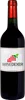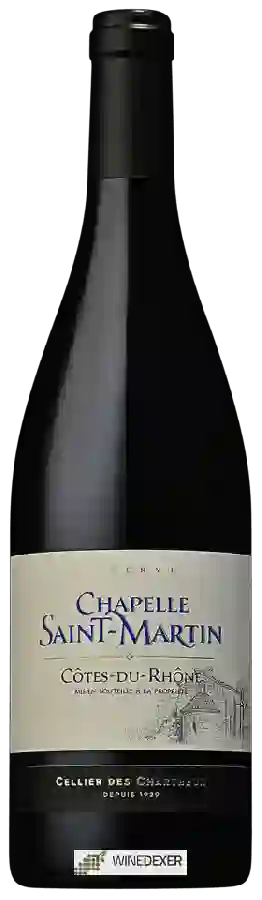
Winery Cellier des ChartreuxChapelle Saint-Martin Reserve Côtes-du-Rhône
 Red wine


In the mouth this red wine is a powerful with a nice balance between acidity and tannins.
This wine generally goes well with beef, game (deer, venison) or lamb.

Taste structure of the Chapelle Saint-Martin Reserve Côtes-du-Rhône from the Winery Cellier des Chartreux
Light | Bold | |
Smooth | Tannic | |
Dry | Sweet | |
Soft | Acidic |
In the mouth the Chapelle Saint-Martin Reserve Côtes-du-Rhône of Winery Cellier des Chartreux in the region of Rhone Valley is a powerful with a nice balance between acidity and tannins.
Food and wine pairings with Chapelle Saint-Martin Reserve Côtes-du-Rhône
Pairings that work perfectly with Chapelle Saint-Martin Reserve Côtes-du-Rhône



Original food and wine pairings with Chapelle Saint-Martin Reserve Côtes-du-Rhône
The Chapelle Saint-Martin Reserve Côtes-du-Rhône of Winery Cellier des Chartreux matches generally quite well with dishes of beef, lamb or game (deer, venison) such as recipes of baked marrow bones, original mafé with okra or paella valenciana (without seafood).
Details and technical informations about Winery Cellier des Chartreux's Chapelle Saint-Martin Reserve Côtes-du-Rhône.
Discover the grape variety: Mourvèdre
Powerful, deep reds with firm tannins and dense texture, showing aromas of blackberry, leather, garrigue, black pepper, liquorice and animal notes (game, forest floor) with age. Star of Bandol AOC as a single variety and pillar of Châteauneuf-du-Pape, Gigondas and Costières blends. Also in GSM in Languedoc and Australia. A late-ripening variety of Spanish origin (Mataró/Monastrell).
Last vintages of this wine

The best vintages of Chapelle Saint-Martin Reserve Côtes-du-Rhône from Winery Cellier des Chartreux are 2013, 2018, 2016, 2010 and 2015.
Informations about the Winery Cellier des Chartreux
The Winery Cellier des Chartreux is one of of the world's great estates. It offers 72 wines for sale in the of Côtes-du-Rhône to come and discover on site or to buy online.

The wine region of Côtes-du-Rhône
Accessible reference for Mediterranean reds: dominant Grenache as king (≥50% in the south) - supple and fruity with notes of cherry, strawberry, garrigue, pepper and a touch of sweet spices, round tannins. Fleshy Syrah (blackcurrant, violet, black pepper), dense Mourvèdre, Cinsault and Carignan in support. In the north, racy, deep Syrah solo. Generous rosés and floral whites (Grenache Blanc, Clairette, Viognier).
The wine region of Rhone Valley
France's 2nd-largest AOC vineyard, two complementary worlds. Northern: pure Syrah in signature reds (Côte-Rôtie, Hermitage, Cornas), deep and peppery with blackberry, violet, black olive and smoked bacon notes, exceptional ageing. Opulent Viognier whites (Condrieu, apricot, flowers) and ample Marsanne-Roussanne. Southern: sun-soaked Grenache blends at Châteauneuf, Gigondas, Vacqueyras (candied fruit, garrigue).
The word of the wine: Roast (taste of)
Characteristic taste of wines made from grapes affected by botrytis cinerea.