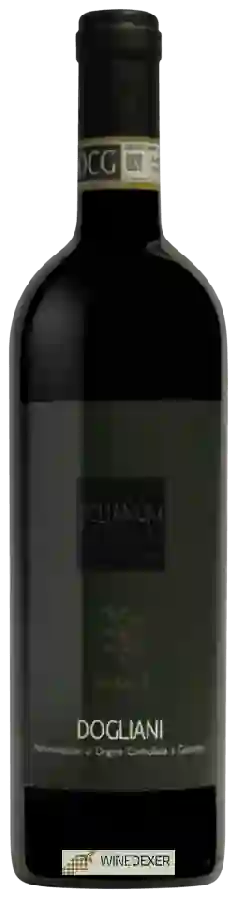
Winery Cantina del Dolcetto di DoglianiDolianum Sanmaté Dogliani
 Red wine


In the mouth this red wine is a powerful with a lot of tannins present in the mouth.
This wine generally goes well with beef, game (deer, venison) or lamb.
The Dolianum Sanmaté Dogliani of the Winery Cantina del Dolcetto di Dogliani is in the top 30 of wines of Dogliani.
Taste structure of the Dolianum Sanmaté Dogliani from the Winery Cantina del Dolcetto di Dogliani
Light | Bold | |
Smooth | Tannic | |
Dry | Sweet | |
Soft | Acidic |
In the mouth the Dolianum Sanmaté Dogliani of Winery Cantina del Dolcetto di Dogliani in the region of Piedmont is a powerful with a lot of tannins present in the mouth.
Wine flavors and olphactive analysis




On the nose the Dolianum Sanmaté Dogliani of Winery Cantina del Dolcetto di Dogliani in the region of Piedmont often reveals types of flavors of oak, spices or black fruit.
Food and wine pairings with Dolianum Sanmaté Dogliani
Pairings that work perfectly with Dolianum Sanmaté Dogliani



Original food and wine pairings with Dolianum Sanmaté Dogliani

The Dolianum Sanmaté Dogliani of Winery Cantina del Dolcetto di Dogliani matches generally quite well with dishes of beef, pasta or lamb such as recipes of traditional flemish carbonades, meat and cheese pie or berber giblet frying pan.
Details and technical informations about Winery Cantina del Dolcetto di Dogliani's Dolianum Sanmaté Dogliani.
Discover the grape variety: Négret castrais
The négret castrais is called mauzac noir. It is in the region of Toulouse that we find this variety doomed to disappear. Its origins are to be found in the Gaillac region, where it reaches maturity during the second period. The plant likes clay-limestone soils. It can be recognized by its late buds. Its bunches have short peduncles bearing compact, truncated cone-shaped loads. They are often winged and loaded with medium-sized berries. The pulp is covered with a thick skin whose colour is more or less red depending on the sun exposure of the bunch. Worms, excoliosis and powdery mildew are the main enemies of this variety. When vinified, Castres Negret gives off a fairly good character from its mauzac stock. The wine gives off notes of vanilla, apple, pear and jasmine. The juice is not very colourful and light in the mouth.
Last vintages of this wine
The best vintages of Dolianum Sanmaté Dogliani from Winery Cantina del Dolcetto di Dogliani are 2010, 2015, 2011, 0 and 2013.
Informations about the Winery Cantina del Dolcetto di Dogliani
The Winery Cantina del Dolcetto di Dogliani is one of of the world's greatest estates. It offers 22 wines for sale in the of Dogliani to come and discover on site or to buy online.

The wine region of Dogliani
The wine region of Dogliani is located in the region of Piémont of Italy. Wineries and vineyards like the Domaine San Fereolo or the Domaine Anna Maria Abbona produce mainly wines red, sparkling and pink. The most planted grape varieties in the region of Dogliani are Nebbiolo, Sangiovese and Merlot, they are then used in wines in blends or as a single variety. On the nose of Dogliani often reveals types of flavors of cream, red cherry or dried herbs and sometimes also flavors of tar, red fruit or black fruit.
The wine region of Piedmont
Piedmont (Piemonte) holds an unrivalled place among the world's finest wine regions. Located in northwestern Italy, it is home to more DOCG wines than any other Italian region, including such well-known and respected names as Barolo, Barbaresco and Barbera d'Asti. Though famous for its Austere, Tannic, Floral">floral reds made from Nebbiolo, Piedmont's biggest success story in the past decade has been Moscato d'Asti, a Sweet, Sparkling white wine. Piedmont Lies, as its name suggests, at the foot of the Western Alps, which encircle its northern and western sides and form its naturally formidable border with Provence, France.
The word of the wine: Presses
The juice that results from pressing the grapes after fermentation. At the end of the maceration, the vats are emptied, the first juice obtained is called the free-run wine and the marc remaining at the bottom of the vat is then pressed to give the press wine. We say more quickly "the presses". Their quality varies according to the vintage and the maceration. A too vigorous extraction releases the tannins of pips and the wine of press can then prove to be very astringent. Often the winemaker raises it separately, deciding later whether or not to incorporate it totally or partially into the grand vin.