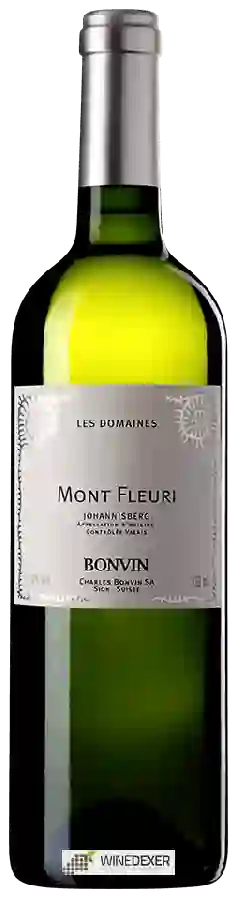
Winery Charles BonvinMont Fleuri Johannisberg
 White wine



This wine generally goes well with

Details and technical informations about Winery Charles Bonvin's Mont Fleuri Johannisberg.
Discover the grape variety: Clairette Rose
Lively, aromatic rosés and clarets with a pale salmon robe, an airy palate, and signature aromas of white flowers (hawthorn), citrus (grapefruit), light red fruits (strawberry, redcurrant) and Mediterranean notes. Occasionally contributing to traditional Provençal and Languedoc rosé blends, it is cultivated in small quantities in Provence and Languedoc-Roussillon. A pink-skinned mutation of Clairette, a historic southern French variety.
Last vintages of this wine
The best vintages of Mont Fleuri Johannisberg from Winery Charles Bonvin are 2015, 2018, 2014, 0 and 2016.
Informations about the Winery Charles Bonvin
The Winery Charles Bonvin is one of of the world's great estates. It offers 80 wines for sale in the of Valais to come and discover on site or to buy online.

The wine region of Valais
Switzerland's largest vineyard, capital of native grapes. Straight, precise alpine whites: light, floral Chasselas (Fendant), signature Petite Arvine with saline, grapefruit and rhubarb notes, rich, apricoty Amigne, mineral Humagne Blanche. Altitude reds: fine Pinot Noir, crisp Gamay, native Cornalin and Humagne Rouge, spicy and deep. Highly precise alpine age-worthy wines.
The word of the wine: Film
Skin of the grape containing the colouring matter of red wines (anthocyanins), the most noble tannins and the essential aromatic substances.