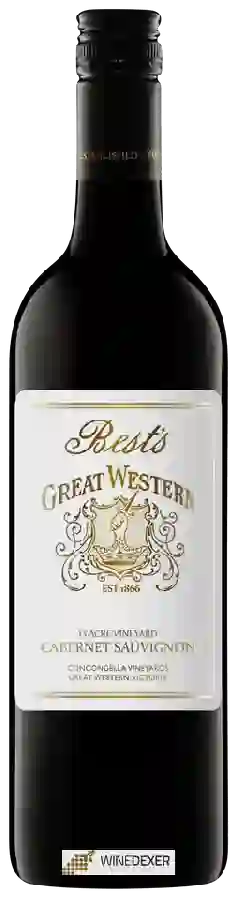
Winery Best'sConcongella 13 Acre Vineyard Cabernet Sauvignon
 Red wine


In the mouth this red wine is a powerful with a nice balance between acidity and tannins.
This wine generally goes well with poultry, beef or lamb.

Taste structure of the Concongella 13 Acre Vineyard Cabernet Sauvignon from the Winery Best's
Light | Bold | |
Smooth | Tannic | |
Dry | Sweet | |
Soft | Acidic |
In the mouth the Concongella 13 Acre Vineyard Cabernet Sauvignon of Winery Best's in the region of Victoria is a powerful with a nice balance between acidity and tannins.
Wine flavors and olphactive analysis


On the nose the Concongella 13 Acre Vineyard Cabernet Sauvignon of Winery Best's in the region of Victoria often reveals types of flavors of earth, black fruit.
Food and wine pairings with Concongella 13 Acre Vineyard Cabernet Sauvignon
Pairings that work perfectly with Concongella 13 Acre Vineyard Cabernet Sauvignon



Original food and wine pairings with Concongella 13 Acre Vineyard Cabernet Sauvignon
The Concongella 13 Acre Vineyard Cabernet Sauvignon of Winery Best's matches generally quite well with dishes of beef, lamb or poultry such as recipes of monkfish (anglerfish) à la sétoise, leg or shoulder of lamb with honey and thyme or north welsch.
Details and technical informations about Winery Best's's Concongella 13 Acre Vineyard Cabernet Sauvignon.
Discover the grape variety: Cabernet-Sauvignon
Structured, tannic reds, deeply coloured, with aromas of blackcurrant, blackberry, cedar, tobacco and graphite, underpinned by firm acidity and fine ageing potential. Cornerstone of the great Médoc estates (Pauillac, Saint-Estèphe, Saint-Julien) and signature of Napa Valley, Coonawarra and Maipo. The world's most planted red variety, a natural cross of Cabernet Franc x Sauvignon Blanc born in Bordeaux.
Last vintages of this wine
The best vintages of Concongella 13 Acre Vineyard Cabernet Sauvignon from Winery Best's are 0
Informations about the Winery Best's
The Winery Best's is one of of the world's great estates. It offers 75 wines for sale in the of Great Western to come and discover on site or to buy online.

The wine region of Great Western
Historical heart of the Grampians (Victoria, Australia), producing wine since 1860 and the Australian birthplace of Sparkling Shiraz, its emblematic speciality since the early 20th century. Still Shiraz shows a peppery, spiced cool-climate profile; Pinot Noir and Dolcetto also notable. Historic estates Seppelt (1868) and Best's hold Australia's oldest vines. Altitude at the foot of the Grampians and Pyrenees ranges; unique cool-climate Shiraz identity and red sparkling tradition.
The wine region of Victoria
Australian diversity from cool to temperate climate. Yarra Valley and Mornington: fine, silky Pinot Noir (cherry, raspberry, undergrowth), taut, mineral Chardonnay. Heathcote: structured Shiraz with black fruits, pepper and chocolate. Rutherglen, fortified capital: opulent sweet Topaque and Muscat (raisin, caramel, fig, roast notes).
The word of the wine: Deposit
Solid particles that can naturally coat the bottom of a bottle of wine. It is rather a guarantee that the wine has not been mistreated: in fact, to avoid the natural deposit, rather violent processes of filtration or cold passage (- 7 or - 8 °C) are used in order to precipitate the tartar (the small white crystals that some people confuse with crystallized sugar: just taste to dissuade you from it)