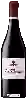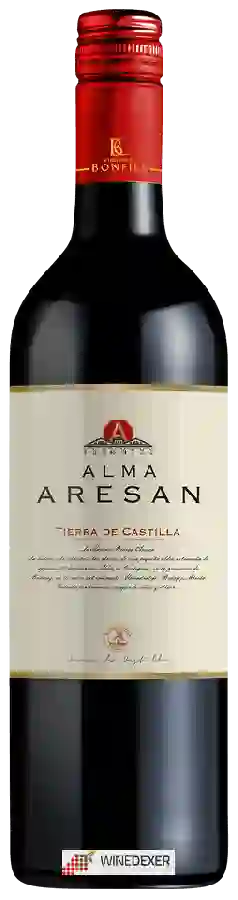
Winery Alma AresanTinto
 Red wine


This wine is a blend of 3 varietals which are the Cabernet-Sauvignon, the Tempranillo and the Merlot.
In the mouth this red wine is a powerful.
This wine generally goes well with poultry, beef or veal.

Taste structure of the Tinto from the Winery Alma Aresan
Light | Bold | |
Smooth | Tannic | |
Dry | Sweet | |
Soft | Acidic |
In the mouth the Tinto of Winery Alma Aresan in the region of Castille is a powerful.
Food and wine pairings with Tinto
Pairings that work perfectly with Tinto



Original food and wine pairings with Tinto

The Tinto of Winery Alma Aresan matches generally quite well with dishes of beef, pasta or veal such as recipes of caramelized beef with onions, three ways to prepare chinese noodles or veal simmered with vegetables.
Details and technical informations about Winery Alma Aresan's Tinto.
Discover the grape variety: Cabernet-Sauvignon
Structured, tannic reds, deeply coloured, with aromas of blackcurrant, blackberry, cedar, tobacco and graphite, underpinned by firm acidity and fine ageing potential. Cornerstone of the great Médoc estates (Pauillac, Saint-Estèphe, Saint-Julien) and signature of Napa Valley, Coonawarra and Maipo. The world's most planted red variety, a natural cross of Cabernet Franc x Sauvignon Blanc born in Bordeaux.
Last vintages of this wine
The best vintages of Tinto from Winery Alma Aresan are 2015, 2014, 2016
Informations about the Winery Alma Aresan
The Winery Alma Aresan is one of of the world's greatest estates. It offers 3 wines for sale in the of Castille to come and discover on site or to buy online.

The wine region of Castille
Cradle of great Castilian reds, high-altitude plateaus (450-1000 m) along the Duero. Tempranillo king (aka Tinta de Toro, Tinto Fino): powerful, concentrated, structured reds with notes of black cherry, plum, leather, tobacco and spice, firm tannins from altitude and cool nights. Stars: Ribera del Duero (Vega Sicilia, Pingus), fleshy Toro, Bierzo (floral, mineral Mencía). Lively, herbaceous Verdejo whites from Rueda.
The word of the wine: Bordeaux barrel
Barrels of 220 to 225 litres. The toasting of the barrel to bend the staves (curved boards used to make the barrels) can vary according to the coopers and the demand. A gentle and slow toasting has little effect on the aromas. On the other hand, a strong toasting gives aromas of coffee or cocoa which will influence the taste of the wine. A wine barrel has already been aged for a year and has less impact on the wine than a new barrel.