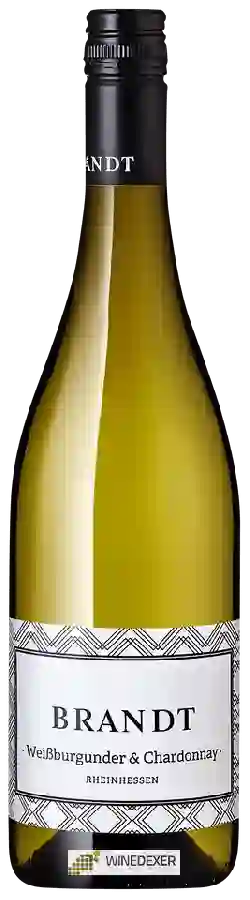
Weingut BrandtWeissburgunder - Chardonnay
 White wine
This wine generally goes well with pork, vegetarian or poultry.
Food and wine pairings with Weissburgunder - Chardonnay
Pairings that work perfectly with Weissburgunder - Chardonnay



Original food and wine pairings with Weissburgunder - Chardonnay

The Weissburgunder - Chardonnay of Weingut Brandt matches generally quite well with dishes of pork, rich fish (salmon, tuna etc) or vegetarian such as recipes of quiche without eggs, grilled sea bass with herbs or summer tuna quiche.
Details and technical informations about Weingut Brandt's Weissburgunder - Chardonnay.
Discover the grape variety: Chardonnay
The white Chardonnay is a grape variety that originated in France (Burgundy). It produces a variety of grape specially used for wine making. It is rare to find this grape to eat on our tables. This variety of grape is characterized by small bunches, and small grapes. White Chardonnay can be found in many vineyards: South West, Burgundy, Jura, Languedoc & Roussillon, Cognac, Bordeaux, Beaujolais, Savoie & Bugey, Loire Valley, Champagne, Rhone Valley, Armagnac, Lorraine, Alsace, Provence & Corsica.
Informations about the Weingut Brandt
The Weingut Brandt is one of of the world's great estates. It offers 29 wines for sale in the of Rheinhessen to come and discover on site or to buy online.

The wine region of Rheinhessen
Rheinhessen is Germany's largest region for producing the quality wines of the Qualitätswein bestimmter Anbaugebiete (QbA) and Prädikatswein designations, with roughly 26,500 hectares (65,000 acres) of Vineyard">Vineyards as of 2014. Many of its most significant viticultural areas are favorably influenced by the Rhine river, which runs aLong its North and eastern borders. The Rhine, along with the Nahe river to the west and the Haardt mountains to its South, form a natural border. Rheinhessen covers an area south of Rheingau, north of Pfalz and east of Nahe, and is located within the Rhineland-Palatinate federal state.
The word of the wine: Yeast
Micro-organisms at the base of all fermentative processes. A wide variety of yeasts live and thrive naturally in the vineyard, provided that treatments do not destroy them. Unfortunately, their replacement by laboratory-selected yeasts is often the order of the day and contributes to the standardization of the wine. Yeasts are indeed involved in the development of certain aromas.