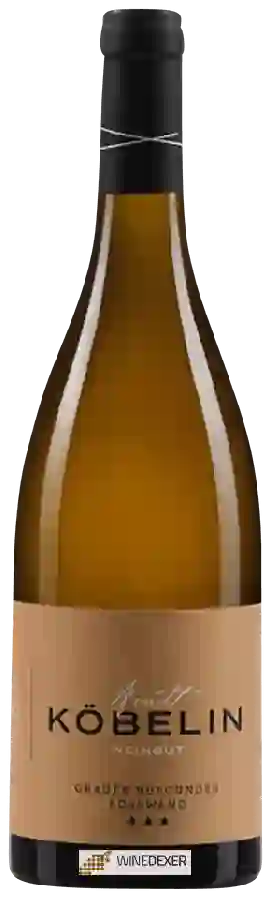
Weingut Arndt KöbelinGrauer Burgunder Lösswand
 White wine


In the mouth this white wine is a powerful.
This wine generally goes well with pork, cured meat or mushrooms.
Taste structure of the Grauer Burgunder Lösswand from the Weingut Arndt Köbelin
Light | Bold | |
Dry | Sweet | |
Soft | Acidic |
In the mouth the Grauer Burgunder Lösswand of Weingut Arndt Köbelin in the region of Baden is a powerful.
Food and wine pairings with Grauer Burgunder Lösswand
Pairings that work perfectly with Grauer Burgunder Lösswand


Original food and wine pairings with Grauer Burgunder Lösswand

The Grauer Burgunder Lösswand of Weingut Arndt Köbelin matches generally quite well with dishes of pork, spicy food or mushrooms such as recipes of alsatian sauerkraut, real paella recipe from valencia or filets of lamb with morels.
Details and technical informations about Weingut Arndt Köbelin's Grauer Burgunder Lösswand.
Discover the grape variety: Reine des vignes
Obtained in Hungary in 1916 by Jean (Janos) Mathiasz by crossing the Beirut date tree with the Csaba pearl. This variety is nowadays very little multiplied, but it is registered in the Official Catalogue of table grape varieties list A1.
Last vintages of this wine
The best vintages of Grauer Burgunder Lösswand from Weingut Arndt Köbelin are 2016, 2018, 2017, 0 and 2015.
Informations about the Weingut Arndt Köbelin
The Weingut Arndt Köbelin is one of of the world's greatest estates. It offers 31 wines for sale in the of Baden to come and discover on site or to buy online.

The wine region of Baden
Baden is the southernmost of Germany's 13 official wine regions. It is also the warmest. Its relatively sunny, DryClimate permits the production of good-quality Spätburgunder (Pinot Noir) and ripe, relatively Full-bodied">Full-bodied examples of Grauburgunder (Pinot Gris) and Weissburgunder (Pinot Blanc). These are often made in oaked styles.
The word of the wine: Terroir
Strictly speaking, the notion of terroir corresponds to the geological characteristics of a vineyard. However, when we talk about terroir, we take into account the soil, the climate (even the microclimate), the flora, the fauna, and the human factor that characterizes the practices that make up the art of the craft.